What Will Yamuna Expressway Look Like by 2035?
 Facebook
 LinkedIn
 WhatsApp
 X
X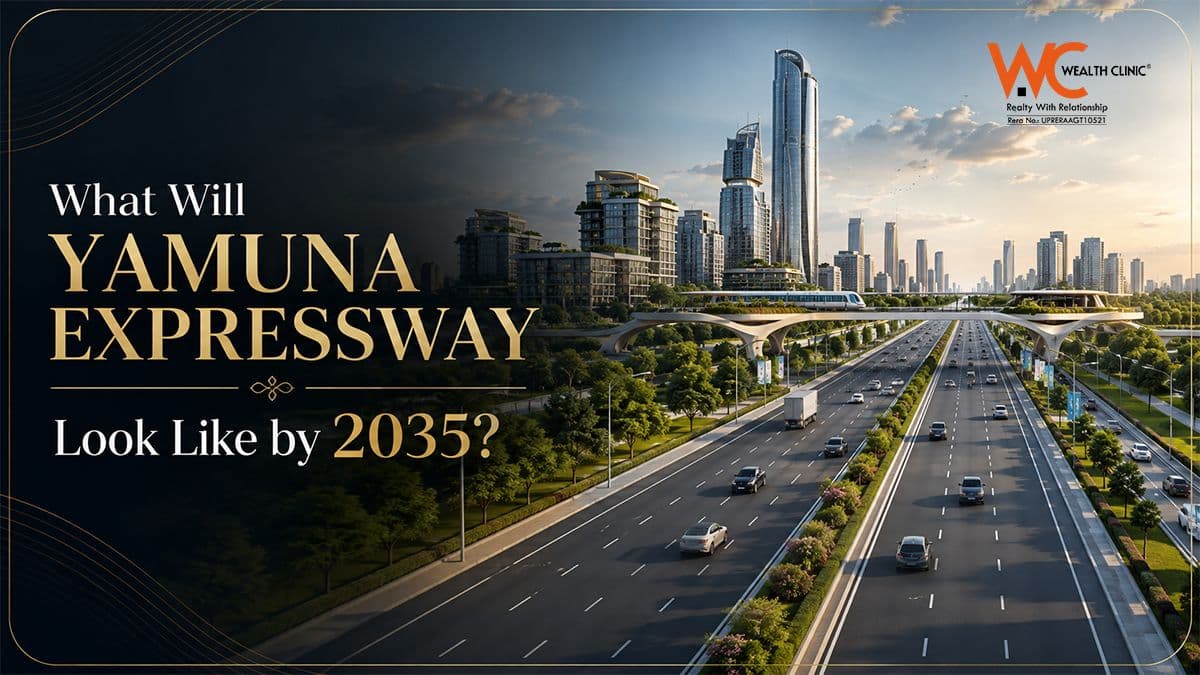
In 2019, the Yamuna Expressway was a long empty road with scattered housing clusters and a lot of agricultural land.
In 2026, it has an operational international airport, a Film City under construction, a Semiconductor Park in development, two large universities, and plot appreciation of up to 536% in six years.
By 2035, it will be something else entirely. Here is what the infrastructure pipeline tells us.
The Airport: From 12 Million to 70 Million Passengers
Noida International Airport at Jewar is live as of June 2026, handling 12 million passengers annually in Phase 1. The full four-phase build-out will handle over 70 million passengers per year.
By 2035, the airport will likely be in Phase 2 or Phase 3 operation. International routes that currently cover select destinations will extend to dozens of cities across Asia, the Middle East, and Europe.
An airport serving 40 to 50 million passengers generates its own gravitational pull. Hotels, aviation MROs, cargo facilities, logistics hubs, F&B, retail, and a permanent residential population of aviation workers all cluster around it. The zone within 10 to 15 km of the terminal will look like a fully built aerotropolis, India's first at this scale.
The Metro: The Single Biggest Re
Rating Event Still Ahead
The proposed 35 km metro from Knowledge Park II to Noida International Airport is planned but not yet under construction as of July 2026.
This is the most consequential infrastructure event still ahead for the corridor.
When it is built, travel times from Noida city centre to the airport will drop to 30 to 40 minutes. Commuting from expressway sectors to Greater Noida will become practical for a much larger population. Based on every metro project in India, property values along the confirmed route will reprice sharply, before construction is complete.
By 2035, this metro will almost certainly be operational. Projects purchased in 2026 and 2027 along its planned route capture the full appreciation arc, from pre-announcement to full operations.
Film City: A Media Economy Forming
The 1,000-acre Film City in Sector 21 is already receiving shoots in temporary facilities. Full infrastructure buildout is expected by 2027 to 2029.
By 2035, it will be one of the largest integrated media production hubs in Asia. The jobs it creates, production, post-production, VFX, hospitality, logistics, administration, are urban, salaried, and generate strong residential rental demand in surrounding sectors.
Think of what Film City Mumbai did to Goregaon and the Western Suburbs over two decades. That is the reference point, at a larger scale and in a corridor that started from a much lower base.
Sectors 28 to 32, closest to the Film City zone, are already at circle rates of ₹20,000 to ₹24,000 per sq. mt. By 2035 with the hub fully operational, those zones will reflect a materially more established market.
Semiconductor and Industrial Clusters
The Semiconductor Park near Jewar is attracting global chip manufacturing interest, backed by India's semiconductor mission with significant central government funding. EV and electronics clusters in Sectors 29, 32, and 34 are part of a broader plan to make this belt India's high-value manufacturing corridor.
By 2035, if even a portion of announced semiconductor and EV investment materialises — and multiple companies have already signed MoUs, the corridor will have a deep, stable employment base that supports residential demand independently of the airport.
This manufacturing ecosystem is the long-duration anchor that makes the Yamuna Expressway more than just an airport story.
Settled Townships Replacing Development
Stage Sectors
YEIDA's development master plan covers 2,689 sq. km, including 6 districts and over 1,187 villages across Uttar Pradesh. New townships, residential sectors, and commercial hubs are being planned and allotted in phases.
By 2035, sectors that are currently agricultural or early-stage will be populated with organised retail, schools, hospitals, and social infrastructure. The corridor will have transitioned from development-stage to settled urban across much of its length.
Authority plot allotments, Sectors 15C, 18, 22D, and 24A, are actively being offered right now at YEIDA rates. These sectors will look very different in 2035 than they do today.
What Property Prices Could Look Like in 2035
Precise numbers nine years out are not honest. But ranges based on comparable corridors are reasonable.
These are estimates, not guarantees. The direction is supported by funded infrastructure, confirmed approvals, and projects already under construction. The timeline depends on execution pace.
What This Means for Investors Right Now
The investors who will look back on 2026 the way Ayodhya investors look back on 2020 are those who identified the right zone, chose RERA-compliant projects, and held through the infrastructure settlement period.
Each milestone that gets crossed, metro confirmation, Film City opening, Semiconductor Park employment, adjusts the entry price upward as risk reduces and demand firms. The current window, where the airport is live but most other catalysts are still building, is the best remaining risk-reward point on this corridor.
2026 and 2027 are still early in that sequence.
Conclusion
By 2035, the Yamuna Expressway will have:
- An airport handling 40 to 50 million passengers
- A metro connecting it to central Noida
- A 1,000-acre Film City fully operational
- Semiconductor and EV manufacturing providing durable employment
- Settled townships replacing today's development-stage sectors
- Property values in the right zones 3 to 5 times current levels
None of this is guaranteed. But the infrastructure is funded, the approvals are in place, and the assets are being built right now.
What the corridor becomes by 2035 is not a hope. It is a plan in progress.
Frequently Asked Questions

Disclaimer
Wealth Clinic is a real estate consulting and marketing company offering property advisory services to homebuyers and investors. Project details, pricing, layouts, specifications, and availability are provided by respective developers or publicly available sources and may change without notice. Wealth Clinic does not own or develop the listed projects and acts solely as a consulting partner. All bookings and agreements are between the buyer and the respective developer. Buyers are advised to verify project details, RERA registration, pricing, approvals, and legal documents with the developer before making any purchase or investment decision.