Why Invest in Yamuna Expressway Real Estate in 2026?

 Facebook
 LinkedIn
 WhatsApp
 X
X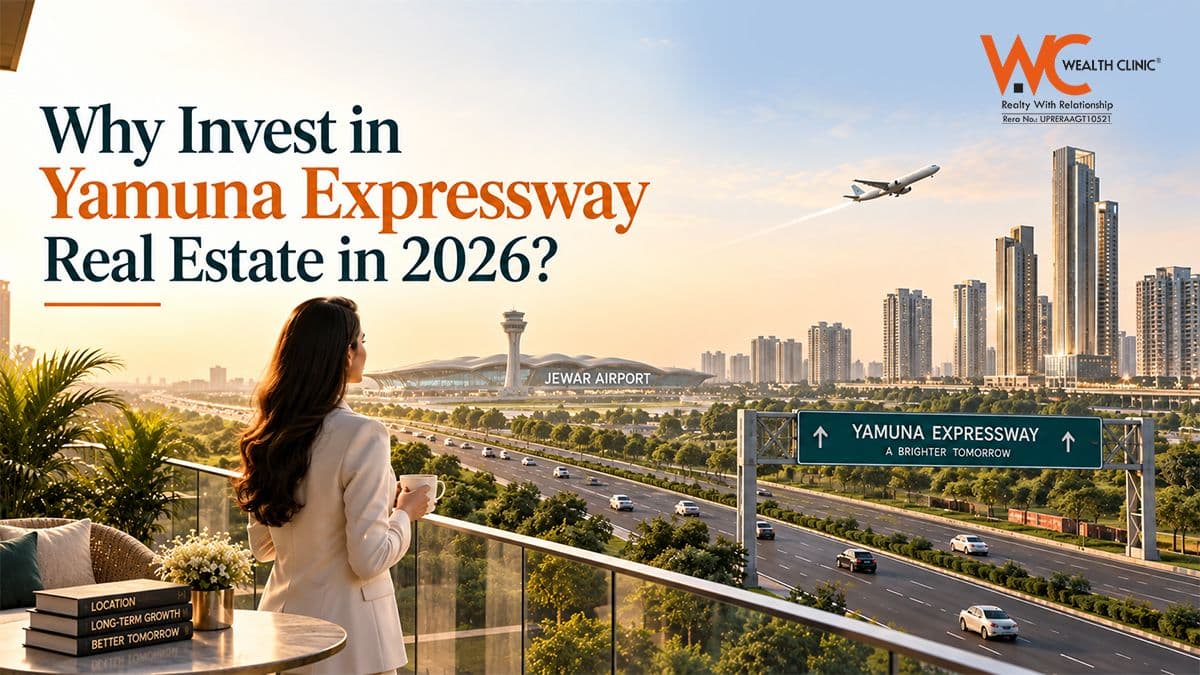
The Yamuna Expressway is emerging as a major real estate and economic development corridor in Uttar Pradesh. In 2026, the region's growth story is no longer limited to road connectivity or residential projects.
The development of the Noida International Airport, industrial parks, logistics infrastructure, international business clusters, Film City, medical facilities and planned transport networks is creating a much broader ecosystem.
For property buyers, this makes an important question worth asking:
Why invest in Yamuna Expressway real estate in 2026?
The answer lies in the combination of infrastructure, employment, industrial development, connectivity and long-term urban planning.
Yamuna Expressway: From Expressway to Growth Corridor
The Yamuna Expressway is approximately 165 km long and connects major locations including Greater Noida, Jewar, Vrindavan, Mathura and Agra.
It is also connected to important road networks including the Noida-Greater Noida Expressway, Eastern Peripheral Expressway and Lucknow-Agra Expressway, with connectivity planned towards the upcoming Ganga Expressway.
According to the supplied YEIDA presentation, the region hosts 10+ industry-specific parks, making industrial diversification one of the major parts of its development story.
This changing economic profile is important for real estate because property demand is often influenced by the growth of jobs, businesses, transportation and urban infrastructure.
1. Noida International Airport Is Now a Major Growth Driver
One of the biggest developments transforming the Yamuna Expressway region is the Noida International Airport.
According to the supplied material, the airport was inaugurated on 28 March 2026. Phase 1 is planned for a passenger capacity of 12 million passengers annually, while the total project area is approximately 7,200 acres. The airport's significance extends beyond passengers.
An airport can support a wider ecosystem involving:
- Aviation
- Logistics
- Hospitality
- Tourism
- Retail
- Offices
- Manufacturing
- Warehousing
- Supporting services
The source specifically identifies residential, commercial and industrial real estate as areas that can benefit from airport-led development.
For property buyers, the key consideration is therefore not simply "How close is the property to the airport?" But what other economic activity is developing around it?
2. Airport Cargo Infrastructure Adds a Commercial Dimension
The Yamuna Expressway's airport is also connected with cargo and logistics.
The PDF states that the Multi-Modal Cargo Hub began cargo operations on 17 June 2026, handling its first domestic freighter carrying 20 tonnes.
The hub has an initial capacity of approximately 2.5 lakh metric tonnes annually, with the potential to scale to 18 lakh metric tonnes at full build-out. It also includes around 22,000 sq. m. of warehouse space and temperature-controlled facilities.
For the real estate market, logistics infrastructure can create demand for:
- Warehouses
- Industrial units
- Commercial spaces
- Offices
- Employee accommodation
- Supporting retail
This makes the corridor relevant to both residential and commercial property buyers.
3. A Large Industrial Ecosystem Is Taking Shape
The Yamuna Expressway is being planned as more than a residential destination.
The YEIDA industrial ecosystem highlighted in the source includes:
- Semiconductor Park
- Electronics Manufacturing Cluster
- Medical Device Park
- EV Manufacturing Park
- Data Centre Park
- Apparel Park
- Furniture Manufacturing Park
- Handicraft Park
- Toy Park
- Logistics Park
- Metro Coach Factory
- MRO facilities
This diversity matters because different industries can generate different types of employment and supporting business activity.
For real estate, that can potentially translate into demand for housing, rentals, offices, retail and other services.
4. Semiconductor and Electronics Manufacturing Can Create Employment Hubs
The semiconductor and electronics sectors are among the key developments highlighted in the YEIDA plan.
The Electronics Manufacturing Cluster is planned across Sectors 10 and 24, covering 206 acres in Sector 10 and 100 acres in Sector 24. The source states that the project was approved under the MeitY EMC 2.0 scheme and received environmental clearance in July 2026.
It projects 31,000 direct and indirect jobs at full operation.
The Semiconductor Park is planned across Sectors 10 and 28. The source estimates that the development could generate 65,000+ direct and indirect jobs, although these are projections and should not be treated as guaranteed employment figures.
For residential investors, employment centres can be important because employees need homes and rental accommodation close to workplaces.
5. Japanese, Korean, Taiwanese and Singaporean Ecosystems
Another factor making the Yamuna Expressway different from a conventional residential corridor is the planned development of international business ecosystems.
Japanese City – Sector 5A
The Japanese City is planned across approximately 395 hectares and targets electronics manufacturing, semiconductors, AI equipment, chip manufacturing and cameras.
The plan also includes housing for the Japanese workforce, schools, hospitals and cultural spaces.
Korean City – Sector 4A
The Korean City is planned across approximately 365 hectares as a multiple-land-use zone combining industrial, residential, commercial and institutional uses.
The proposed development includes workforce housing, schools, hospitals and essential amenities.
Singapore City – Sector 7
Singapore City is planned across approximately 500 acres as a multi-purpose industrial ecosystem for Singaporean companies and their supply-chain partners.
The plan includes industrial plots, residential units, commercial facilities and institutional infrastructure.
These developments can potentially create additional demand for residential and commercial property as businesses and employees become part of the regional ecosystem.
6. Film City Could Add Another Demand Driver
The International Film City in Sector 21 is another major project highlighted in the source.
The planned Film City covers approximately 1,000 acres, with a 230-acre Phase 1 footprint. The project includes proposed film studios, OTT sets, a theme park, podcast studios, a media centre and a film institute.
The source also states that the project is around 4 km from Jewar Airport and is planned with dedicated expressway ramps.
A large entertainment and media ecosystem can create demand for hospitality, retail, commercial spaces and accommodation.
For property buyers, this is another development worth tracking within the broader Yamuna Expressway ecosystem.
7. Medical and Education Infrastructure Is Expanding
Real estate growth is not sustainable on industrial development alone. People also need healthcare and education.
The YEIDA plan includes a 500-acre Medical Hub across Sectors 13 and 14, with proposed super-speciality hospitals, a medical college, research centres, AYUSH facilities, diagnostics and medical tourism infrastructure.
A University Township is also planned across Sectors 14 and 34, covering a combined 516 acres according to the supplied material.
The development is intended to attract universities, research institutions and knowledge-based enterprises.
For residential buyers, access to education and healthcare is an important part of long-term liveability.
8. Better Regional Connectivity Could Support Property Demand
Connectivity remains one of the most important factors when evaluating any real estate market.
The Yamuna Expressway already provides a major road connection across the region. Beyond this, the source highlights planned rapid rail and high-speed connectivity.
A 71.1-km RRTS route from Ghaziabad towards Jewar, including YEIDA City and Noida International Airport, is identified as a confirmed route in the supplied material.
The source also mentions a planned Delhi-Varanasi high-speed rail corridor with connectivity towards Noida Airport.
However, buyers should always distinguish between operational infrastructure, projects under construction, approved projects and proposals at feasibility or planning stages.
9. The Region Is Planned for Long-Term Urbanisation
YEIDA covers a large planning area and the source highlights development across 3,352 sq. km., 1,149 villages and six districts.
Its development framework includes industrial zones, manufacturing parks, logistics hubs, special economic zones, integrated townships and planned civic infrastructure for 2041.
This long-term planning is significant for property buyers because it provides a broader context for evaluating individual projects.
Instead of looking only at today's surroundings, buyers can study:
What is planned around the property?
This includes future roads, employment centres, commercial zones, educational institutions and public infrastructure.
10. MRO and Aviation-Related Development Adds to the Ecosystem
The airport region is also seeing aviation-related infrastructure. According to the source, the foundation stone for the MRO facility was laid on 28 March 2026.
Phase 1 covers 40 acres within the airport premises, while a much larger Phase 2 of approximately 1,365 acres is planned. Akasa Air is identified as the first MRO operator in the source material.
MRO activity can support aviation-related employment and associated businesses, further strengthening the airport-led economic ecosystem.
11. Residential Property Can Benefit From Economic Growth
When industrial parks, airports, offices and institutions develop, people need places to live.
This can create different forms of residential demand:
- Apartments for end users
- Rental homes for employees
- Plotted developments
- Serviced accommodation
- Housing close to employment hubs
The PDF projects significant employment generation across multiple sectors in the YEIDA region. It also projects airport-related employment across aviation, logistics, tourism, hospitality, IT, manufacturing, media and healthcare.
However, these figures are projections. Actual housing demand will depend on how quickly individual projects become operational and how employment and population growth materialise.
12. Commercial Property Has Multiple Potential Demand Sources
Commercial real estate in the Yamuna Expressway region can potentially benefit from several sectors developing simultaneously. These include:
Airport + Logistics + Manufacturing + Offices + Retail + Healthcare + Education + Entertainment
This diversification can be relevant for commercial property buyers because demand does not necessarily depend on a single industry.
However, investors should assess actual footfall, tenant demand, business activity, occupancy and surrounding development before purchasing commercial property.
Which Property Should You Consider on Yamuna Expressway?
There is no single property type suitable for every buyer.
Residential Apartments
These may be relevant for end users and buyers looking for housing close to emerging employment centres.
Plots
Plots can appeal to buyers who prefer land-based investments, but title, land use, approvals and development status require careful verification.
Commercial Property
Commercial spaces may suit buyers targeting business and rental demand, but location, footfall, tenant profile and occupancy should be evaluated carefully.
Industrial or Logistics Property
This segment may be relevant to businesses and investors with a specific understanding of industrial demand and regulations.
The right choice depends on the buyer's budget, purpose, risk tolerance and investment horizon.
What Should You Check Before Investing?
The Yamuna Expressway development story is strong in terms of planned infrastructure, but property buyers should still conduct proper due diligence.
Check RERA Registration
For applicable projects, verify the project's RERA registration and current status.
Verify Property Documents
For plots and land, check ownership, title, land use and applicable approvals.
Check the Developer
Review the developer's track record, project status and previous delivery record.
Study the Exact Location
Don't rely only on the distance mentioned in advertisements. Check the property's actual location and access roads.
Separate Current From Future Infrastructure
An operational airport, an under-construction project and a proposed transport link should not be treated as the same thing.
Compare Total Costs
Include registration, taxes, maintenance, financing and other applicable charges—not just the advertised property price.
Is Yamuna Expressway a Good Investment in 2026?
The Yamuna Expressway presents a multi-sector development story in 2026.
The Noida International Airport, cargo infrastructure, industrial parks, international business ecosystems, Film City, medical and education infrastructure and planned transport connectivity are all contributing to the region's development.
But "good investment" depends on the individual property and the buyer's objectives.
A property close to an employment hub may have a different demand profile from a project located farther away. Similarly, an operational commercial centre should be evaluated differently from a project that depends mainly on future development.
Therefore, investors should focus on location, approvals, pricing, development status, connectivity, rental demand and long-term use case.
Final Takeaway
The biggest reason to watch Yamuna Expressway real estate in 2026 is the scale and diversity of development taking place across the region.
It is not just about the Noida International Airport.
The broader story includes:
Airport + Industrial Parks + International Investment + Logistics + Semiconductor & Electronics + Film City + Healthcare + Education + Transport Infrastructure
Together, these developments are shaping the Yamuna Expressway into a more diversified economic corridor.
For property buyers, the opportunity is not simply to buy near an upcoming infrastructure project. The more important step is to identify where actual employment, connectivity, social infrastructure and business activity are developing, and then evaluate the property on its own fundamentals.
Frequently Asked Questions

Disclaimer
Wealth Clinic is a real estate consulting and marketing company offering property advisory services to homebuyers and investors. Project details, pricing, layouts, specifications, and availability are provided by respective developers or publicly available sources and may change without notice. Wealth Clinic does not own or develop the listed projects and acts solely as a consulting partner. All bookings and agreements are between the buyer and the respective developer. Buyers are advised to verify project details, RERA registration, pricing, approvals, and legal documents with the developer before making any purchase or investment decision.