Japanese City, Korean City, Singapore City on Yamuna Expressway — What It Means for Property Buyers

 Facebook
 LinkedIn
 WhatsApp
 X
X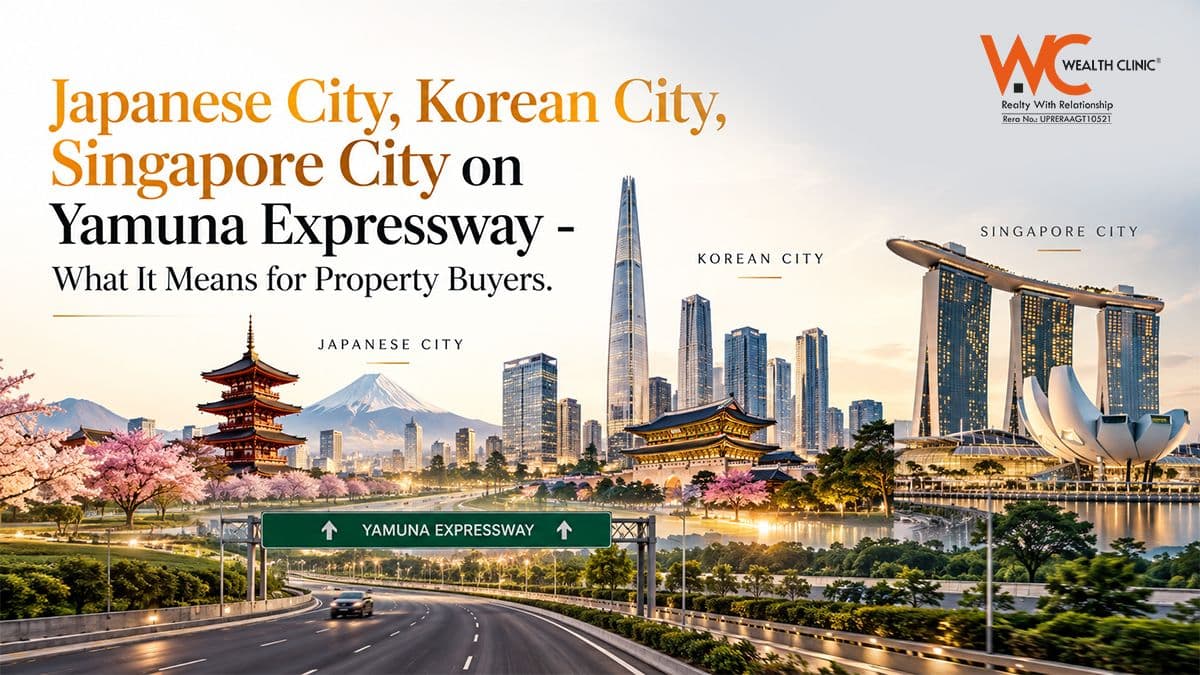
The Yamuna Expressway is gradually developing beyond a residential property market.
With Japanese City in Sector 5A, Korean City in Sector 4A and Singapore City in Sector 7, the YEIDA region is being planned as a destination for international companies, manufacturing, supply-chain businesses and supporting urban infrastructure.
For property buyers, these developments matter because industrial investment can create demand for homes, rental accommodation, offices, retail and everyday services around employment centres.
But what exactly are these three international cities, and what could they mean for real estate?
Explore Properties in Yamuna Expressway | Book a Free Consultation
What Are Japanese City, Korean City and Singapore City?
These are planned international business and industrial ecosystems within the YEIDA region, designed to attract companies from Japan, South Korea and Singapore along with their supply-chain partners.
The proposed zones combine industrial activity with supporting residential, commercial and institutional infrastructure.
This is significant because the development model is not simply about creating factories. The plans also include facilities intended to support the people and businesses working within these ecosystems.
1. Japanese City — Sector 5A
The Japanese City is planned across approximately 395 hectares, or around 976 acres, in Sector 5A.
According to the source material, it is planned as a multi-purpose industrial zone, with a minimum of 70% of the land designated for industrial activities.
The targeted industries include:
- Electronics manufacturing
- Semiconductors
- AI equipment
- Chip manufacturing
- Cameras
The plan also includes housing for the Japanese workforce, schools, hospitals and cultural spaces.
What could this mean for property buyers?
The combination of industrial facilities and workforce housing can create a more complete employment ecosystem.
For residential buyers, the important factor is not simply the presence of Japanese companies. It is whether the development leads to sustained employment, supporting businesses and actual population movement into the surrounding areas.
This could create potential demand for:
- Residential apartments
- Plotted developments
- Rental housing
- Serviced accommodation
- Retail and daily-use businesses
- Commercial spaces
However, buyers should evaluate each property's exact location and development status rather than assuming that every nearby project will benefit equally.
Explore Properties in Yamuna Expressway | Book a Free Consultation
Korean City
Sector 4A
The Korean City is planned across approximately 365 hectares, or around 900 acres, in Sector 4A.
The source describes it as a multiple-land-use zone, combining:
- Industrial
- Residential
- Commercial
- Institutional uses
A South Korean government delegation visited YEIDA on 26 June 2026, including representatives from South Korea's Ministry of Trade, Industry & Resources, the Embassy of the Republic of Korea and KOTRA.
The proposed ecosystem is intended to include housing for the Korean workforce, schools, hospitals and essential amenities.
Why does this matter for real estate?
A self-contained industrial ecosystem can potentially reduce the distance between workplaces and residential areas. For property buyers, this creates an important question:
Where will employees, suppliers and supporting businesses live and operate?
If industrial activity develops as planned, surrounding residential and commercial areas could see additional demand.
This is particularly relevant for buyers looking at properties with access to employment zones, transport routes and established social infrastructure.
3. Singapore City — Sector 7
The proposed Singapore City is planned across approximately 500 acres in Sector 7. The source describes it as a multi-purpose industrial zone, with at least 70% of the land intended for industrial activities.
The planned ecosystem is designed for Singaporean companies and their supply-chain partners.
The development model includes:
- Industrial plots
- Residential units for the Singapore workforce
- Commercial facilities
- Institutional infrastructure
What could it mean for nearby property?
Singapore City adds another international business ecosystem to an already expanding industrial corridor. For property buyers, its relevance could come from the supporting demand generated by employees, businesses and services.
However, the source does not provide an officially stated employment figure for Singapore City. Therefore, buyers should avoid assuming a specific number of jobs or a guaranteed impact on property prices.
Explore Properties in Yamuna Expressway | Book a Free Consultation
Why Are These International Cities Important for Yamuna Expressway?
The bigger story is economic diversification. The YEIDA region is developing multiple specialised industrial parks, including electronics, semiconductor, EV, medical devices, apparel, logistics, data centres, furniture, toys and other manufacturing sectors.
The Japanese, Korean and Singaporean ecosystems add another layer of international business activity.
This means the Yamuna Expressway's future development is increasingly connected to:
Manufacturing + Technology + Logistics + Aviation + International Investment + Urbanisation
For real estate, such diversification can be important because residential and commercial demand generally develops alongside employment and business activity.
How Can International Industrial Development Affect Property Demand?
1. More Employment Can Support Housing Demand
Industrial parks require employees at different levels—from manufacturing and technical professionals to management, logistics and support services.
As businesses become operational, housing demand can emerge around employment centres.
The source material identifies projected employment across several YEIDA industrial developments, although actual employment will depend on implementation and operationalisation of individual projects.
For residential buyers, this makes proximity to employment centres an important factor to consider.
2. Rental Housing Could Become More Relevant
International companies can bring employees, executives, technical professionals and supporting workers into a location. Not everyone will immediately purchase a home.
Some may prefer:
- Rental apartments
- Furnished accommodation
- Serviced residences
- Housing close to workplaces
This can create a potential rental market around established employment clusters.
But rental demand should be evaluated using actual occupancy, existing tenant demand and local rental levels rather than future projections alone.
3. Commercial Real Estate Could Benefit
Employees also need services. As industrial ecosystems develop, supporting demand can emerge for:
- Restaurants
- Cafés
- Convenience retail
- Banks
- Clinics
- Professional services
- Offices
- Warehouses
- Business centres
The proposed international cities themselves include commercial and institutional components, particularly the Korean and Singapore City plans.
This creates potential opportunities beyond residential property.
Japanese City vs Korean City vs Singapore City
The figures and development descriptions above are from the supplied YEIDA presentation.
What About Taiwan City?
The internationalisation of the YEIDA region does not stop with Japan, South Korea and Singapore. The source also highlights a Taiwan City in Sector 6, covering approximately 300 acres, along with a pharmaceutical formulation manufacturing cluster of around 100–125 acres.
The planned Taiwan ecosystem is intended for Taiwanese companies and their supply-chain partners, with integration of Indian MSMEs into global Taiwanese supply chains.
For property buyers, this strengthens the broader picture of YEIDA as an emerging international industrial and business corridor rather than a purely residential destination.
How the Airport Connects With This Growth
The international industrial ecosystem is developing alongside the Noida International Airport.
The source states that the airport was inaugurated on 28 March 2026, with Phase 1 planned for approximately 12 million passengers annually and a total project area of around 7,200 acres.
Cargo infrastructure is also becoming part of the ecosystem.
The Multi-Modal Cargo Hub began cargo operations in June 2026, with an initial annual capacity of approximately 2.5 lakh metric tonnes, scalable to 18 lakh metric tonnes at full build-out.
For international manufacturers and exporters, airport and cargo connectivity can be particularly relevant.
For property buyers, this creates another factor to consider: access to both employment hubs and transport infrastructure.
What Does This Mean for Residential Property Buyers?
If you are considering a home or residential investment in the Yamuna Expressway region, don't look at the international cities in isolation.
Instead, assess the entire surrounding ecosystem.
Check these five factors:
1. Distance from employment centres: How easily can residents reach industrial and commercial zones?
2. Road and public transport connectivity: Look at existing connectivity first and treat proposed infrastructure separately.
3. Social infrastructure: Schools, hospitals, retail and daily-use facilities can influence liveability.
4. Project approvals and developer credentials: Verify RERA registration where applicable and check project documents before investing.
5. Actual development progress: A planned city and an operational business hub are not the same thing. Check what is currently developed, under construction or only proposed.
What Does This Mean for Commercial Property Buyers?
Commercial buyers can look at a different set of indicators. Potential demand may come from:
- Supplier companies
- Service businesses
- Retail
- Food and hospitality
- Offices
- Logistics
- Warehousing
- Business support services
The key is to identify locations where actual business activity is developing, rather than purchasing solely on the expectation of future demand.
Is International Investment a Guarantee of Property Appreciation?
No, The arrival or proposed development of international industrial clusters can support economic activity, employment and infrastructure, but it does not guarantee that property prices will increase.
Real estate performance depends on several factors, including:
- Location
- Project quality
- Supply and demand
- Infrastructure completion
- Employment growth
- Connectivity
- Pricing
- Rental demand
- Regulatory approvals
- Overall economic conditions
This distinction is particularly important in an emerging corridor where some projects are operational while others are still under development or planning.
What Should Property Buyers Watch Next?
For buyers tracking the Yamuna Expressway, several developments are worth monitoring together:
- Japanese City – Sector 5A
- Korean City – Sector 4A
- Singapore City – Sector 7
- Taiwan City – Sector 6
- Noida International Airport
- Airport cargo hub
- Semiconductor Park
- Electronics Manufacturing Cluster
- Medical Device Park
- International Film City
- Logistics infrastructure
- Planned RRTS connectivity
- YEIDA Master Plan 2041
These projects form part of a much wider development ecosystem across the YEIDA region.
Final Takeaway
The development of Japanese City, Korean City and Singapore City adds a new dimension to the Yamuna Expressway real estate story.
Their importance for property buyers comes from the potential connection between international businesses, industrial employment, housing, commercial activity and supporting infrastructure.
The Japanese City is focused strongly on electronics and semiconductor-related industries. The Korean City is planned as a mixed-use international ecosystem, while Singapore City is designed around Singaporean companies and their supply chains.
For buyers, the right approach is to look beyond the name of an upcoming project or international city. Study the actual development status, surrounding infrastructure, connectivity, property pricing, approvals and end-user or rental demand.
The Yamuna Expressway is being planned as a large, multi-sector economic corridor. For property buyers, understanding where the jobs, infrastructure and real business activity are developing can be just as important as the property itself.
Frequently Asked Questions

Disclaimer
Wealth Clinic is a real estate consulting and marketing company offering property advisory services to homebuyers and investors. Project details, pricing, layouts, specifications, and availability are provided by respective developers or publicly available sources and may change without notice. Wealth Clinic does not own or develop the listed projects and acts solely as a consulting partner. All bookings and agreements are between the buyer and the respective developer. Buyers are advised to verify project details, RERA registration, pricing, approvals, and legal documents with the developer before making any purchase or investment decision.