New Noida (DNGIR): Master Plan, Investment Guide 2026
 Facebook
 LinkedIn
 WhatsApp
 X
X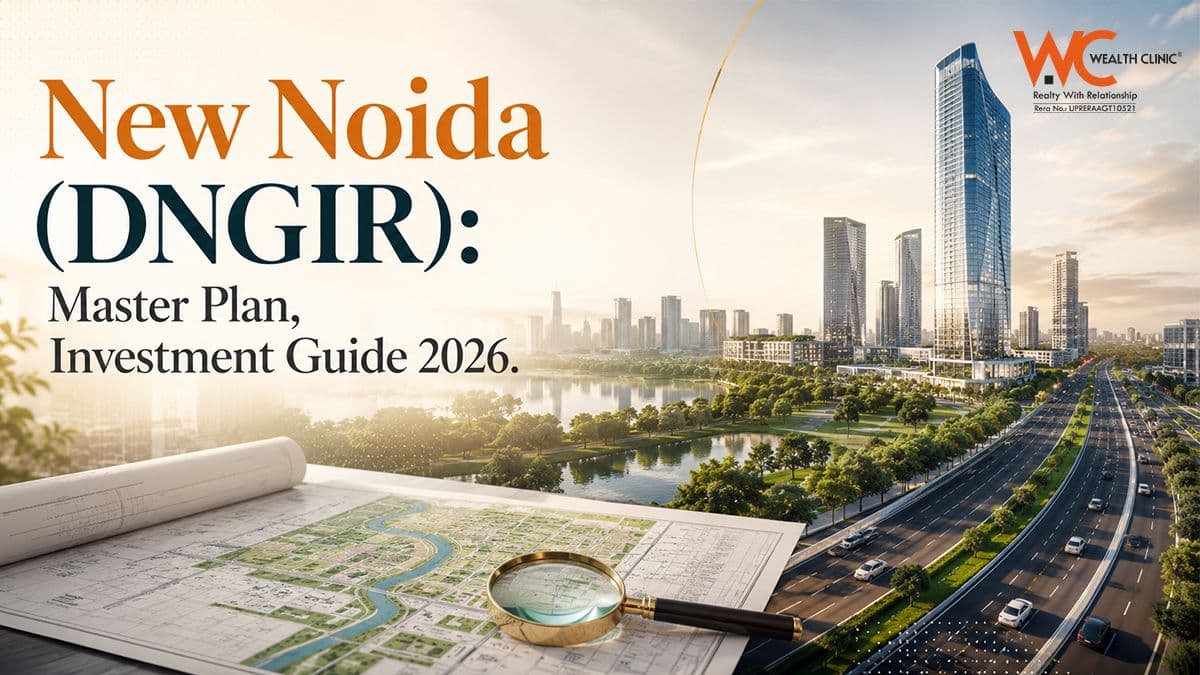
Most people investing in Noida today are looking at the Expressway, the Yamuna Expressway belt, or the Jewar Airport zone.
Very few are looking at what is being planned right next to all of it, a 21,000-hectare city being built from scratch, with government backing, industrial corridors, and residential sectors that are in early allotment right now.
That city is New Noida. Here is everything you need to know.
What Is New Noida (DNGIR)?
DNGIR- Dadri-Noida-Ghaziabad Investment Region, is the official name. It is being marketed and referred to as New Noida.
It is a planned urban and industrial development zone spread across 20,000 to 21,000 hectares in Gautam Buddha Nagar and Ghaziabad districts of Uttar Pradesh. It falls within the National Capital Region and is being developed under the Delhi-Mumbai Industrial Corridor (DMIC) framework, India's largest infrastructure programme.
Key numbers:
- Total planned area: 21,000 hectares
- Phase 1: 3,165 hectares, first to be developed
- Projected population by 2041: 6 lakh residents
- Projected direct and indirect jobs: 6 lakh+
- Development authorities: UPEIDA and YEIDA in coordination with DMIC Development Corporation
Where Is It Located?
New Noida sits to the east and south-east of existing Noida and Greater Noida. It is bounded by:
- Noida and Greater Noida to the west
- Ghaziabad to the north
- Yamuna Expressway to the south-east
- Bulandshahr to the east
This location puts it at the intersection of two of NCR's most active growth corridors, the Greater Noida-Noida belt and the Yamuna Expressway-Jewar Airport zone.
Jewar International Airport is approximately 30 to 40 km from the New Noida development zone. Planned expressway upgrades and metro connectivity will reduce effective travel time significantly once built.
The Master Plan, What Is Being Built
The DNGIR Master Plan is a phased development blueprint covering land use, infrastructure, industrial zones, and residential sectors.
Land use mix:
- Industrial and manufacturing: ~40%
- Residential: ~22%
- Green and open spaces: ~15%
- Commercial, institutional, and utilities: ~23%
Phase 1 — What Is Happening Now (3,165 hectares):
- Internal road network, arterial roads and sector roads being laid
- Power infrastructure, dedicated substations
- Water supply and sewage systems from the planning stage
- Industrial plot allotments begun
- Residential sector planning underway
Infrastructure planned for full development:
- Metro connectivity extending from the existing Noida metro network
- Expressway access, direct connectivity to NH-9 and the Yamuna Expressway belt
- Dedicated freight corridor access, critical for manufacturing and logistics businesses
- IT and knowledge parks alongside manufacturing clusters
- Social infrastructure, schools, hospitals, markets built into sector planning from day one
Industrial Focus, What Kind of Jobs and Economy
This is what makes DNGIR different from a purely residential project. The industrial backbone is what creates the housing demand that drives real estate values.
Priority industrial sectors:
- Electronics and semiconductor manufacturing, aligned with India's national semiconductor mission and central government PLI (Production-Linked Incentive) schemes
- Defence equipment manufacturing, UP has been designated a key defence manufacturing hub
- Electric vehicles and EV components, UP government actively attracting EV manufacturers
- Logistics and warehousing, proximity to dedicated freight corridor and Jewar Airport
- Pharmaceuticals, a growing sector across the UP industrial belt
- Textiles and apparel, leveraging UP's existing manufacturing base
The industrial zones are not speculative. They are backed by central government industrial corridor funding, state government PLI schemes, and MoUs already signed with multiple manufacturers.
Property Investment in New Noida, The Opportunity
Understanding why DNGIR matters for investors requires looking at what early entry into comparable planned cities has produced.
Comparison with historical planned developments:
- Noida (Phase 1 development from 1976): Early investors have seen 50x+ returns over 45 years
- Greater Noida (from 1991): Early authority plot allottees saw 20 to 30x over 25 years
- Yamuna Expressway (YEIDA from 2010): Plot appreciation up to 536% in 5 years in airport-adjacent sectors
DNGIR is at the beginning of that curve. The early-stage risk is higher. So is the return potential for investors with the right timeline.
Current indicative prices:
- Authority residential plot allotments: ₹15,000–₹30,000 per sq. mt.
- Private developer residential launches: ₹3,500–₹6,500 per sq. ft. (early-stage pricing)
- Industrial plot allotments: At UPEIDA development cost rates, the most attractive entry for industrial investors
These prices reflect the current early-development status. Phase 1 infrastructure delivery will be the first significant re-rating event.
Zone
Wise Investment Areas Within DNGIR
Not all of DNGIR is equally positioned for early investment. The zones closest to existing Noida and Greater Noida, and those adjacent to the expressway connectivity points, are the highest-priority for early-stage residential and commercial investment.
Zone 1- Adjacent to Greater Noida (closest to existing city): Residential sectors closest to the developed edge of Greater Noida. These benefit from immediate connectivity to schools, hospitals, and retail that already exist. Fastest to settle. Highest current prices within the zone.
Zone 2- Industrial core (Phase 1 development focus): The active industrial allotment area. Not for residential buyers but the employment generator that will drive residential demand in surrounding sectors for the next 15 years.
Zone 3- Expressway and freight corridor adjacency: Areas adjacent to the planned expressway and freight corridor access. Logistics, warehousing, and supporting commercial real estate. Long-term play.
Zone 4- Outer development areas (beyond Phase 1): 20+ year development horizon. Land prices are low, development certainty is also low until Phase 2 is formally committed.
Risks Every DNGIR Investor Must Understand
Honesty matters here. DNGIR is a high-potential, high-patience investment. The risks are real.
Development timeline risk: Phase 1 is active. But planned cities in India have a history of delayed social infrastructure, schools, hospitals, retail, public transport, taking longer than the physical planning suggests. Investors should expect a 7 to 10 year horizon before the zone feels like a proper city.
Metro connectivity uncertainty: The planned metro extension to DNGIR is not under construction yet. Without a metro, the zone depends on road-based commuting, which works, but limits the residential market to car-owning professionals.
Developer quality risk: Early-stage zones attract developers who have never operated in the region. UP RERA registration and developer delivery track record are essential checks before any private developer purchase.
Return timeline: This is a 10 to 20 year story. Investors expecting 3 to 5 year returns should look at the Yamuna Expressway or Noida Expressway instead. DNGIR rewards patience more than timing.
Who Should Invest in New Noida in 2026?
Right for:
- Long-horizon investors who missed Noida and Greater Noida early and want an equivalent entry point
- Buyers of authority-allotted plots, government backing reduces some early-stage risk
- Industrial businesses seeking early land near freight corridor and airport connectivity
- Investors with 10+ year holding capacity who understand development-stage real estate
Not right for:
- Buyers who need rental income in the near term — the residential market is too early
- Investors expecting 3 to 5 year exits
- Buyers wanting to use the property for personal living within 5 years
- Anyone not comfortable with development-stage uncertainty
New Noida vs Yamuna Expressway, Which Is the Better Bet in 2026?
Neither is wrong. They serve different investor profiles and timelines.
The Bottom Line
New Noida is India's next planned city at NCR's eastern edge. The master plan is serious, the government backing is real, the industrial pipeline is backed by central funding, and the early allotment prices reflect the development-stage risk rather than the matured-market premium.
Investors who understand that cities take time to build, and who entered Greater Noida or Yamuna Expressway before everyone else did, understand the DNGIR opportunity.
This is not a 2-year play. It is a 10 to 20 year bet on India's urbanisation, industrial growth, and the continued expansion of the NCR economic belt.
For investors with that horizon and the patience to match it, the entry window in 2026 is still open, and the prices still reflect early-stage reality.
Frequently Asked Questions

Disclaimer
Wealth Clinic is a real estate consulting and marketing company offering property advisory services to homebuyers and investors. Project details, pricing, layouts, specifications, and availability are provided by respective developers or publicly available sources and may change without notice. Wealth Clinic does not own or develop the listed projects and acts solely as a consulting partner. All bookings and agreements are between the buyer and the respective developer. Buyers are advised to verify project details, RERA registration, pricing, approvals, and legal documents with the developer before making any purchase or investment decision.