
 Facebook
 LinkedIn
 WhatsApp
 X
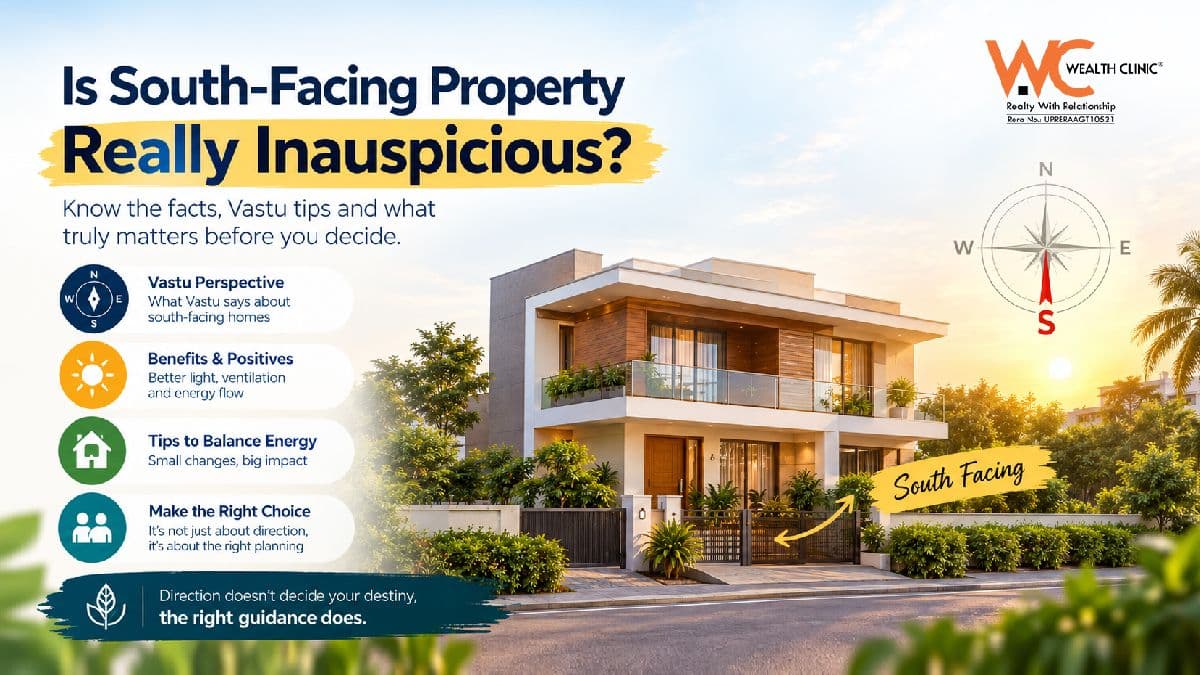
“South-facing property mat lena, Vastu ke hisaab se theek nahi hoti.”
This is something many Indian homebuyers hear while searching for a house or flat. Because of this common belief, buyers sometimes reject a property the moment they learn that it is south-facing.
But is every south-facing property really inauspicious?
No, a south-facing property is not automatically considered bad as per Vastu. The direction of the property is only one part of the assessment. Traditional Vastu also considers the position of the main entrance, room placement, shape of the property and the overall layout.
So, if you are looking at a south-facing flat or house, there is no need to reject it immediately. First understand what the layout actually looks like.
What Does South
Facing Property Mean?
A property is generally called south-facing when you stand inside the main entrance and face outward, and the direction you face is South.
This is important because buyers sometimes confuse the direction of the balcony, road or living-room windows with the actual facing of the property.
For a flat, the safest approach is to check the main entrance direction using a compass and compare it with the builder's floor plan.
Once you know the actual direction, you can look at the rest of the layout.
Is South
Facing House Bad as per Vastu?
The simple answer is not necessarily.
Traditional Vastu does not mean that every property facing South will have the same result. The placement of the main door is considered particularly important, along with how different areas of the home are arranged.
This is why two south-facing houses can have very different Vastu assessments.
One may have a layout that works well with traditional Vastu preferences, while another may have an entrance or room arrangement that a Vastu-conscious buyer may not prefer.
So instead of asking only “Is a south-facing house bad?”, a better question is:
“Is this particular south-facing property well planned?”
Why Is South Direction Considered Negative by Many People?
The fear around South-facing homes has both cultural and traditional roots.
In Hindu traditions, the South is associated with Yama, which has contributed to its association with death. Over time, this has often been simplified into the idea that a South-facing home is automatically unlucky.
However, traditional Vastu principles are more detailed than this common belief.
The direction itself does not tell the complete story. The exact position of the entrance and the internal arrangement of the property also matter. This distinction is especially important for modern homebuyers, because rejecting every South-facing property can unnecessarily reduce the number of options available to them.
Explore Properties in Yamuna Expressway | Book a Free Consultation
Main Door Matters More Than Just “South Facing”
If you are considering a south-facing home, start with the main entrance.
Vastu practitioners traditionally divide each direction into different sections or padas. Some sections of the South side are considered more suitable for an entrance than others. This means a buyer should not simply ask whether the main door is in the South.
Instead, check where on the South side the entrance is located.
For a new flat, this information can usually be checked from the floor plan. Since apartment layouts are generally fixed by the builder, it is better to understand the entrance position before booking the property rather than expecting major changes later.
What About the Kitchen and Bedrooms?
The overall layout is another important part of traditional Vastu. The Southeast is commonly preferred for the kitchen because it is associated with the fire element. The Southwest is traditionally considered suitable for the master bedroom, while the Northeast is often preferred for a prayer or meditation space.
These are traditional Vastu preferences, not scientific rules.
For a homebuyer, they can simply be used as one of the factors while comparing different floor plans.
At the same time, don't ignore practical things. A bedroom should have enough space and ventilation, while a kitchen should have proper exhaust, storage and a workable layout.
Explore Properties in Yamuna Expressway | Book a Free Consultation
Should You Buy a South
Facing Flat?
A south-facing flat can still be worth considering if the property meets your other requirements. Before making a decision, look at:
- Location and connectivity
- Builder reputation
- Construction quality
- Carpet area
- Natural light
- Ventilation
- Floor plan
- Price and total purchase cost
- RERA and other applicable approvals
- Property documentation
- Maintenance and future usability
If Vastu is important to you, add the entrance direction and room placement to this list.
This is a much more practical approach than rejecting a property simply because its direction is South.
What About Sunlight in a South
Facing Home?
Direction also has a practical side that has nothing to do with Vastu.
The amount of heat and sunlight a home receives depends on factors such as location, season, window orientation, building design, shading and surrounding buildings.
Therefore, when visiting a south-facing property, spend some time looking at the actual living conditions.
Does the home receive enough natural light? Does it become uncomfortable during the afternoon? Are the windows shaded? Is there good cross-ventilation?
These questions can tell you much more about everyday comfort than the word “South-facing” on a property brochure.
South
Facing House vs North
North-facing properties are often preferred by Vastu-conscious buyers, but that does not automatically make every north-facing home better than every south-facing one.
Imagine two properties.
- The first is south-facing but has a practical layout, good ventilation, a suitable entrance, clear documents and a location that fits your needs.
- The second is north-facing but has poor ventilation, an awkward layout, weak connectivity and a price that doesn't fit your budget.
In such a situation, looking only at the facing direction would not give you the complete picture.
A property's direction should be considered alongside its overall quality and suitability.
Common Myths About South
Facing Properties
“Every South-Facing House Is Bad”
This is an oversimplification. Traditional Vastu considers the entrance and overall layout, not just the broad facing direction.
“South-Facing Homes Cannot Be Vastu-Friendly”
A south-facing property can be assessed according to traditional Vastu principles. The individual layout matters.
“South-Facing Property Is Bad for Investment”
There is no basis for treating facing direction alone as a reliable indicator of investment performance. Location, pricing, demand, connectivity, development and property quality are far more relevant factors.
“You Should Never Buy a South-Facing Flat”
There is no need for such a blanket rule. If you follow Vastu, assess the specific flat rather than rejecting an entire category of properties.
A Simple Checklist for Buyers
Before booking a south-facing property, check the following:
1. Confirm the direction: Use a compass and verify the actual entrance direction.
2. Check the main door: Look at its exact position on the South side.
3. Review the floor plan: Check the kitchen, bedrooms, toilets and other major spaces.
4. Check the Northeast: Understand what is located in this zone.
5. Visit the property: Look at sunlight, ventilation and overall comfort.
6. Check the documents: Verify the relevant approvals, RERA details and property paperwork.
7. Compare the total cost: Don't let Vastu preferences make you overlook affordability.
Conclusion
So, is a south-facing property really inauspicious?
Not necessarily, The idea that every South-facing home is automatically bad is a common misconception. Traditional Vastu looks at the entrance, internal layout and placement of different areas, rather than treating the property's broad direction as the only deciding factor.
If you are considering a south-facing flat or house, evaluate the property as a whole. Check the floor plan, entrance, natural light, ventilation, location, construction quality, documentation and price.
And if Vastu is important to your family, use it as a personal or cultural preference while making the final decision.
A good home is ultimately one that is legally sound, financially comfortable, practically suitable and right for the people who will live in it.
Frequently Asked Questions

Disclaimer
Wealth Clinic is a real estate consulting and marketing company offering property advisory services to homebuyers and investors. Project details, pricing, layouts, specifications, and availability are provided by respective developers or publicly available sources and may change without notice. Wealth Clinic does not own or develop the listed projects and acts solely as a consulting partner. All bookings and agreements are between the buyer and the respective developer. Buyers are advised to verify project details, RERA registration, pricing, approvals, and legal documents with the developer before making any purchase or investment decision.