
 Facebook
 LinkedIn
 WhatsApp
 X
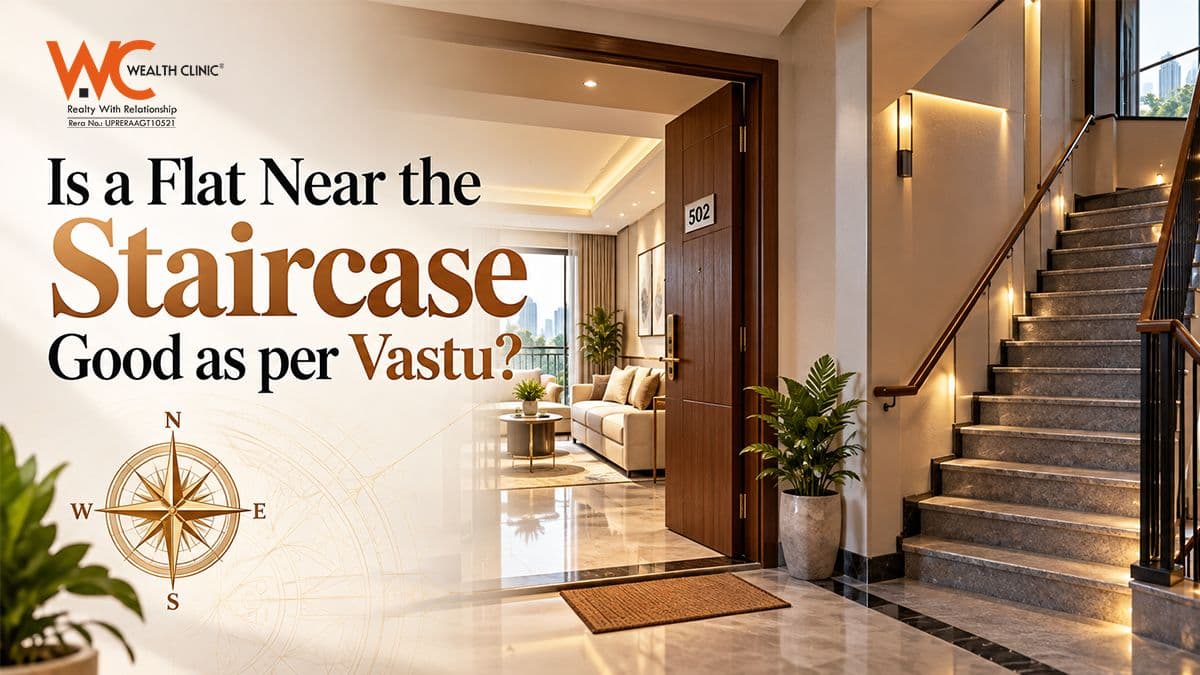
When buying a flat, homebuyers often pay attention to the main entrance, kitchen direction, bedroom placement and natural light. However, another question that sometimes comes up is whether a flat located near a staircase is good as per Vastu.
Some buyers worry that living next to a staircase may affect the home's energy or bring Vastu-related problems. Others are more concerned about noise, privacy and the movement of people outside their entrance.
So, is a flat near the staircase good as per Vastu? The answer depends on the staircase's location, the flat's entrance and overall layout, as well as your practical requirements. Traditional Vastu guidelines consider the placement of staircases and entrances, but a flat being near a staircase does not automatically make it unsuitable.
This guide explains what Vastu traditionally says about flats near staircases, what homebuyers should check before purchasing, and how to balance these beliefs with everyday comfort.
Want to invest in a premium property with the right Vastu? Explore top luxury residential projects
Is a Flat Near the Staircase Good as per Vastu?
According to traditional Vastu Shastra, the placement of a staircase is considered when assessing the layout of a house or building. Some guidelines discuss staircase placement in relation to the cardinal directions, while others focus on the main entrance, circulation and the arrangement of rooms.
However, there is no universal Vastu rule stating that every flat near a staircase is bad. The assessment may vary depending on whether the staircase is inside the flat, directly opposite the entrance, beside the entrance or located in a common area outside the apartment.
For example, a flat next to a common staircase may be perfectly practical if the entrance is private, the passage is well-lit and noise is limited. On the other hand, a staircase that creates constant disturbance or blocks convenient access may be less suitable regardless of Vastu preferences.
If you follow Vastu, consider the exact layout rather than rejecting a flat based only on its proximity to the staircase.
What Does Vastu Say About Staircase Placement?
Traditional Vastu guidelines often recommend placing internal staircases in the south, west or southwest areas of a house. Specific recommendations differ among practitioners, and these guidelines are not scientifically established rules about a property's effect on its occupants.
In an apartment building, the common staircase is usually positioned according to the building's structural design, fire-safety requirements and circulation needs. Individual buyers generally have limited control over its location.
When assessing a flat near a staircase, it is useful to distinguish between two situations:
- An internal staircase: A staircase located within a duplex or multi-level home. Its position may be assessed as part of the home's floor plan.
- A common staircase: A shared staircase in the apartment building, outside the flat. Here, the entrance position, privacy, noise and access are often more relevant to the buyer's decision.
The distinction matters because traditional recommendations for an internal staircase may not apply in the same way to a shared staircase in a residential tower.
Want to invest in a premium property with the right Vastu? Explore top luxury residential projects
Is a Flat With Its Main Door Near the Staircase Good as per Vastu?
A flat with its main entrance near a staircase is not automatically considered unfavourable. The relationship between the staircase and the entrance is more important than proximity alone in many traditional assessments.
If the staircase is beside the entrance, check whether it leaves sufficient space for the door to open and close comfortably. If it is directly opposite the entrance, some Vastu practitioners may assess the arrangement differently, depending on the staircase's position and the layout.
Before making a decision, check the following:
- Is the main entrance easy to access?
- Does the staircase directly face the entrance, or is it simply nearby?
- Is the entrance area well-lit and ventilated?
- Do people frequently gather or pass immediately outside the door?
- Is there sufficient privacy when the main door is open?
- Does the arrangement comply with the building's safety and access requirements?
If Vastu is important to you, share the actual floor plan with a practitioner rather than relying on a general rule about staircase proximity.
Is a Flat Directly Opposite the Staircase Good or Bad?
A flat directly opposite a staircase can raise questions for buyers who follow Vastu. Some traditional interpretations advise examining the entrance carefully when a staircase faces the main door. However, the exact assessment varies, and there is no reliable scientific evidence that this arrangement causes bad luck or financial problems.
From a practical perspective, the distance between the staircase and entrance matters. A staircase that opens onto a busy landing may bring more foot traffic, noise or reduced privacy. A quieter staircase with a properly designed landing may create fewer concerns.
When visiting the property, stand near the entrance and observe how people move through the common area. Check whether the staircase creates a direct line of sight into your home, whether the landing feels cramped and whether the entrance can be kept private.
Practical Problems to Check in a Flat Near the Staircase
Even if you are not concerned about Vastu, a staircase near your flat can affect everyday living. These practical checks are important before booking a property.
1. Noise and Foot Traffic
Residents may use a common staircase throughout the day. If your flat is close to a busy landing, you may hear footsteps, conversations or doors opening and closing.
Visit the property at different times, if possible, to understand how busy the area becomes.
2. Privacy at the Main Entrance
A staircase can create frequent movement just outside your entrance. Consider whether people walking up or down can easily see inside when your door opens.
An entrance layout that offers privacy can make everyday living more comfortable.
3. Natural Light and Ventilation
Check whether the staircase or adjoining walls block light or airflow to your entrance, windows or nearby rooms. A dark or poorly ventilated entrance may feel less welcoming and could require better lighting.
4. Safety and Emergency Access
Common staircases are important escape routes in many residential buildings. Check that the landing is clear, access is not obstructed by stored items and the building has appropriate fire-safety provisions.
Do not place furniture, shoe racks or other items in shared areas if they obstruct access or violate building rules.
5. Dust, Cleanliness and Maintenance
A staircase near the entrance may bring dust or dirt into the area, particularly in buildings with heavy foot traffic. Check the cleanliness of common spaces and ask how frequently the staircase and landing are maintained.
6. Accessibility for Children and Older Adults
If your family includes children, older adults or someone with mobility needs, consider the location of the flat relative to the staircase and lift. Check whether the entrance is easy to reach and whether the common area provides safe, convenient movement.
Vastu Tips for a Flat Near the Staircase
If you follow traditional Vastu principles, you can consider the following general suggestions while keeping the building's design and safety requirements in mind.
Keep the entrance clear. Avoid cluttering the doorway with shoes, boxes or storage units. A clean entrance is easier to use and maintain.
Maintain good lighting. Ensure that the entrance and adjoining passage are adequately lit. Follow building rules when considering any changes to shared areas.
Keep the inside of the entrance organised. A well-arranged foyer or entry space can help maintain privacy and create a more functional transition into the home.
Review the overall floor plan. Consider the entrance direction, room placement, natural light and ventilation rather than judging the flat solely by the staircase location.
Seek advice based on the actual layout. If you are concerned about a particular Vastu arrangement, ask a practitioner to review the floor plan and explain the reasoning behind their recommendation. Avoid costly modifications or decisions based only on fear.
These are general suggestions, not guaranteed remedies for Vastu defects.
Should You Avoid Buying a Flat Near the Staircase?
Not necessarily. A flat near the staircase can be a suitable home if the layout is comfortable, the entrance has enough privacy and the building meets relevant safety requirements.
Before purchasing, evaluate the flat using a balanced checklist:
- Location: Is the property close to your workplace, schools, transport and everyday facilities?
- Layout: Are the rooms well-sized and arranged for your family's needs?
- Entrance: Is it private, accessible and convenient?
- Noise: Does the common staircase create noticeable disturbance?
- Ventilation: Do the entrance and rooms receive adequate airflow and light?
- Safety: Are common areas and escape routes properly maintained?
- Legal checks: Have you reviewed the title documents, applicable approvals, RERA details where relevant and the sale agreement?
- Vastu preferences: If important to your family, has the actual floor plan been assessed rather than just the staircase's proximity?
A property should meet your practical, financial and lifestyle requirements. Vastu preferences can be considered alongside these factors rather than replacing them.
Conclusion
A flat near a staircase is not automatically bad as per Vastu. Traditional assessments may consider the staircase's position, the main entrance and the overall layout, but the guidance can vary depending on the property and the Vastu system being followed.
For homebuyers, the most useful approach is to check both traditional preferences and practical living conditions. Look at privacy, noise, natural light, ventilation, accessibility and building safety before making a final decision.
If you are unsure about the Vastu suitability of a particular flat, review its floor plan with a qualified practitioner. Combine that guidance with independent property due diligence so you can choose a home that fits your family's needs and budget.
Frequently Asked Questions

Disclaimer
Wealth Clinic is a real estate consulting and marketing company offering property advisory services to homebuyers and investors. Project details, pricing, layouts, specifications, and availability are provided by respective developers or publicly available sources and may change without notice. Wealth Clinic does not own or develop the listed projects and acts solely as a consulting partner. All bookings and agreements are between the buyer and the respective developer. Buyers are advised to verify project details, RERA registration, pricing, approvals, and legal documents with the developer before making any purchase or investment decision.