
Why Smart Investors Are Moving from Noida to Yamuna Expressway Right Now

 Facebook
 LinkedIn
 WhatsApp
 X
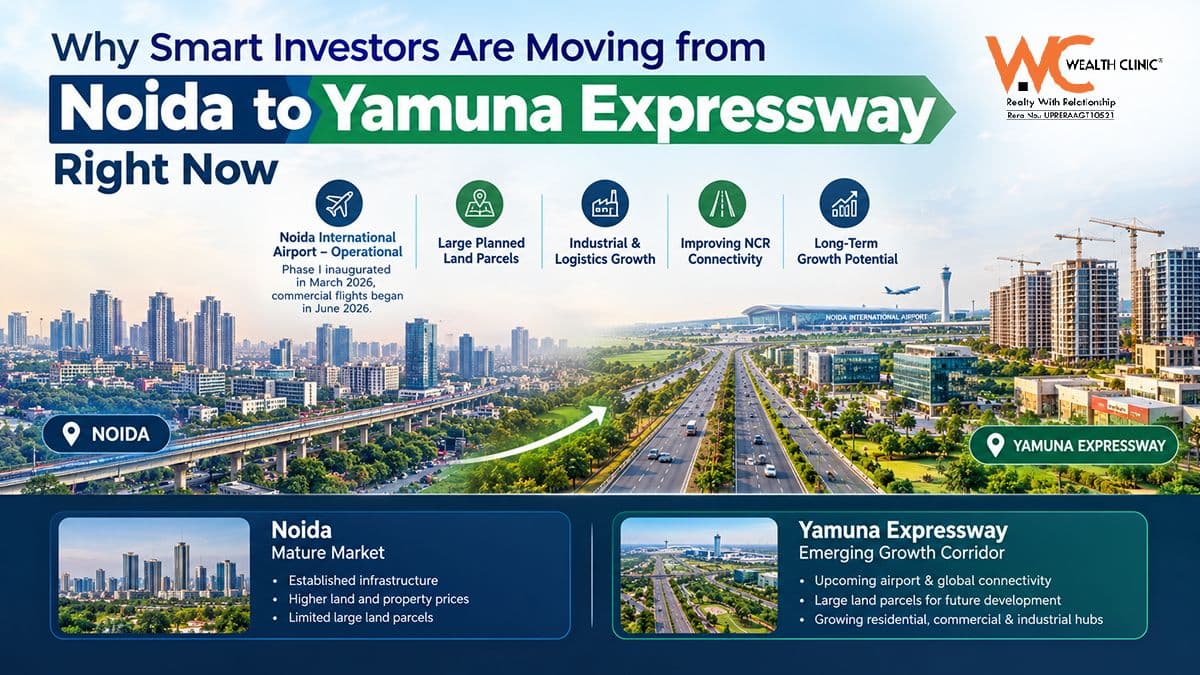
For years, Noida has been one of the most established real estate markets in the Delhi-NCR region. Strong office demand, metro connectivity, expressways, residential communities and commercial development have made it a preferred choice for both end-users and investors.
But in 2026, another NCR corridor is attracting increasing attention: Yamuna Expressway.
The shift is not about Noida losing its importance. Instead, investors are increasingly looking at the next phase of NCR growth, where Noida International Airport, industrial projects, logistics infrastructure, electronics manufacturing and planned urban development are coming together.
With the airport now operational and new investments taking shape around Jewar and YEIDA, Yamuna Expressway is moving from a future-growth story toward an emerging economic corridor.
Explore Properties in Yamuna Expressway | Book a Free Consultation
Noida Is Mature. Yamuna Expressway Is Still Expanding
One of the biggest differences between Noida and Yamuna Expressway is their stage of development.
Noida already has established residential sectors, commercial hubs, IT offices, retail destinations and supporting infrastructure. As a mature market, many locations have already experienced significant development.
Yamuna Expressway, on the other hand, is still building its economic and urban ecosystem.
This includes:
- Noida International Airport
- Electronics and semiconductor manufacturing
- Logistics and cargo infrastructure
- Industrial clusters
- Data centres
- Medical-device manufacturing
- International industrial ecosystems
- Film City
- New residential development
- Commercial and institutional infrastructure
For investors with a longer investment horizon, this difference can be important.
Explore Properties in Yamuna Expressway | Book a Free Consultation
Noida International Airport Has Changed the Equation
The biggest catalyst for Yamuna Expressway is now a reality: Noida International Airport at Jewar. The airport's Phase I was inaugurated on March 28, 2026, with an investment of around ₹11,200 crore.
The airport is not simply an aviation project.
It is expected to influence the wider regional economy through passenger movement, cargo, logistics, business travel and supporting commercial activity. For real estate investors, this creates a different demand story around the corridor. The potential chain is straightforward:
Airport → Jobs → Businesses → Housing → Retail → Commercial Demand
However, investors should remember that infrastructure-led growth takes time. Airport proximity alone does not guarantee property appreciation.
Industrial Growth Is Creating a New Demand Base
The Yamuna Expressway region is increasingly being positioned as an industrial and manufacturing destination.
One of the most significant developments is the HCL-Foxconn semiconductor project in the YEIDA region, which the Government of India described as a milestone for India's high-end electronics and semiconductor manufacturing ecosystem.
In June 2026, electronics manufacturing projects worth approximately ₹6,750 crore were also announced at Yamuna City, Jewar. The projects include an electronics manufacturing cluster spread across 206 acres.
For property investors, industrial development matters because businesses create employment. Employment can subsequently generate demand for:
- Rental housing
- Apartments
- Plotted developments
- Retail
- Restaurants
- Offices
- Hotels
- Serviced accommodation
- Local services
This makes Yamuna Expressway's growth story broader than residential construction alone.
Explore Properties in Yamuna Expressway | Book a Free Consultation
Logistics Could Become a Major Property Demand Driver
Yamuna Expressway has another advantage: its location within a growing logistics network.
The expressway connects Greater Noida toward Agra, while the airport adds a new aviation and cargo component.
The government is also developing additional connectivity between the airport and other parts of NCR. A 31.42-km greenfield connectivity project approved in 2026 is designed to connect Jewar International Airport with the Delhi-Mumbai Expressway while intersecting the Eastern Peripheral Expressway, Yamuna Expressway and Dedicated Freight Corridor.
For investors, logistics growth can support demand for industrial, warehousing and commercial real estate alongside residential development.
Developers Are Increasing Their Presence
Another signal investors are watching is developer activity.
In August 2026, Gaurs Group acquired three land parcels totalling 35 acres in Sector 18 along the Yamuna Expressway for around ₹700 crore, according to PTI. The company plans residential development on the land.
The same month, the developer said its expansion strategy was focused on Noida, Ghaziabad and Yamuna Expressway, including new housing projects.
Large land acquisitions do not guarantee future property returns, but they indicate that established developers are actively evaluating the corridor.
Residential Development Is Following Economic Growth
An important difference between an infrastructure project and a real estate ecosystem is the presence of supporting residential development. As the airport region expands, YEIDA is planning additional facilities for residents.
For example, YEIDA announced plans for a 14-acre Central Park in Sector 20, citing increasing residential and commercial activity following the start of operations at Noida International Airport.
YEIDA has also announced a scheme for school and corporate-office plots near the airport, indicating that institutional and employment-supporting infrastructure is being planned alongside residential growth.
This is important because successful real estate corridors require more than housing projects. They need schools, offices, healthcare, retail, recreation and transportation.
Investors Are Looking at the Next Growth Zone
For an investor, the question is often not:
“Where is the market today?”
It can also be:
“Where is the next major economic ecosystem being built?”
This is where Yamuna Expressway becomes interesting. Noida already has a developed ecosystem. Yamuna Expressway is building one. The difference can be broadly understood as:
This does not mean Yamuna Expressway is automatically a better investment than Noida. It means the two markets offer different investment characteristics.
The Entry Point Is One Reason for the Interest
Another reason investors are examining Yamuna Expressway is the availability of developing micro-markets. Established Noida locations have already undergone substantial urbanisation. Yamuna Expressway has larger pockets where residential, commercial and industrial development is still taking shape. For investors, this can provide more opportunities to evaluate projects based on:
- Location
- Development stage
- Infrastructure access
- Developer credibility
- Land use
- Project approvals
- Expected employment drivers
- Rental potential
- Long-term liquidity
But a lower entry price should never be the only reason to purchase a property.
The Investment Story Is Becoming More Diverse
Earlier, much of the Yamuna Expressway real estate conversation was centred around residential plots and apartments. The economic ecosystem is now becoming broader.
Investors can find opportunities connected to:
- Residential- Apartments, plotted developments and housing near employment centres.
- Commercial- Retail, offices, business spaces and supporting commercial developments.
- Industrial- Manufacturing, industrial plots and supporting businesses.
- Logistics- Warehouses, distribution facilities and supply-chain infrastructure.
- Hospitality- Hotels, serviced apartments and other accommodation linked to airport and business activity.
The emergence of multiple property segments can make the corridor more economically diverse.
The Global Manufacturing Story Adds Another Layer
Yamuna Expressway is also attracting attention because of its emerging role in India's manufacturing ambitions.
The semiconductor ecosystem, electronics manufacturing projects and other industrial clusters could create demand for skilled and semi-skilled workers as projects become operational.
The HCL-Foxconn semiconductor project is particularly significant because the government has positioned it as part of India's effort to build a domestic high-end electronics and semiconductor ecosystem.
For real estate, the important point is not simply the project investment amount.
It is what happens around such projects.
Manufacturing facilities require suppliers, logistics providers, employees, service businesses and supporting infrastructure.
That ecosystem can influence surrounding property demand over time.
Noida Is Not Being Replaced
It is important to put the trend in perspective. Noida continues to have major advantages:
- Established employment hubs
- Metro connectivity
- Mature residential communities
- IT and corporate offices
- Schools and hospitals
- Retail and entertainment
- Existing social infrastructure
The recent ₹1,850-crore bid for a 12.5-acre Sector 108 land parcel also shows that major developers continue to see strong potential in established Noida locations.
So the story is not “Noida is finished.”
It is:
“Investors are increasingly looking beyond established Noida markets toward the next growth corridor.”
What Should Investors Check Before Buying?
Yamuna Expressway has a strong infrastructure and development pipeline, but investors should separate announced projects from operational infrastructure. Before purchasing, check:
1. Exact Location- Don't evaluate the entire Yamuna Expressway as one market. Sector-level differences can be significant.
2. Land Use- Verify whether the property is residential, commercial, industrial or mixed-use as permitted by the relevant authority.
3. RERA Registration- For applicable projects, verify registration and project details through the official RERA portal.
4. Developer Track Record- Check previous projects, delivery history, approvals and construction progress.
5. Actual Connectivity- Consider existing roads and public transport rather than relying entirely on proposed infrastructure.
6. Employment Drivers- Look for actual or progressing industrial, commercial and institutional activity around the project.
7. Exit Liquidity- A property can have a strong future story but still be difficult to sell if there is limited end-user demand.
8. Total Cost- Consider stamp duty, registration, maintenance, taxes, financing costs and other charges, not just the quoted property price.
Is Yamuna Expressway the Next Noida?
It may become an important economic extension of the wider Noida-Greater Noida region, but it is too early to treat the entire corridor as equivalent to established Noida.
What is clear is that the fundamentals are changing.
Noida International Airport is operational. Industrial and electronics projects are progressing. Developers are acquiring land. Residential and commercial activity is expanding. New connectivity projects are being developed.
Together, these factors are creating a substantially different investment landscape from a few years ago.
Conclusion
The growing interest in Yamuna Expressway is less about moving away from Noida and more about looking ahead to the next phase of NCR development.
Noida remains a mature real estate and business market. Yamuna Expressway offers a developing combination of airport connectivity, industrial growth, manufacturing, logistics, residential expansion and new infrastructure.
For investors considering the corridor in 2026, the key is not to chase the latest property trend.
Instead, evaluate where jobs, infrastructure, businesses and actual end-user demand are developing, and whether the specific property can benefit from that growth.
Frequently Asked Questions

Disclaimer
Wealth Clinic is a real estate consulting and marketing company offering property advisory services to homebuyers and investors. Project details, pricing, layouts, specifications, and availability are provided by respective developers or publicly available sources and may change without notice. Wealth Clinic does not own or develop the listed projects and acts solely as a consulting partner. All bookings and agreements are between the buyer and the respective developer. Buyers are advised to verify project details, RERA registration, pricing, approvals, and legal documents with the developer before making any purchase or investment decision.