 Facebook
 LinkedIn
 WhatsApp
 X
X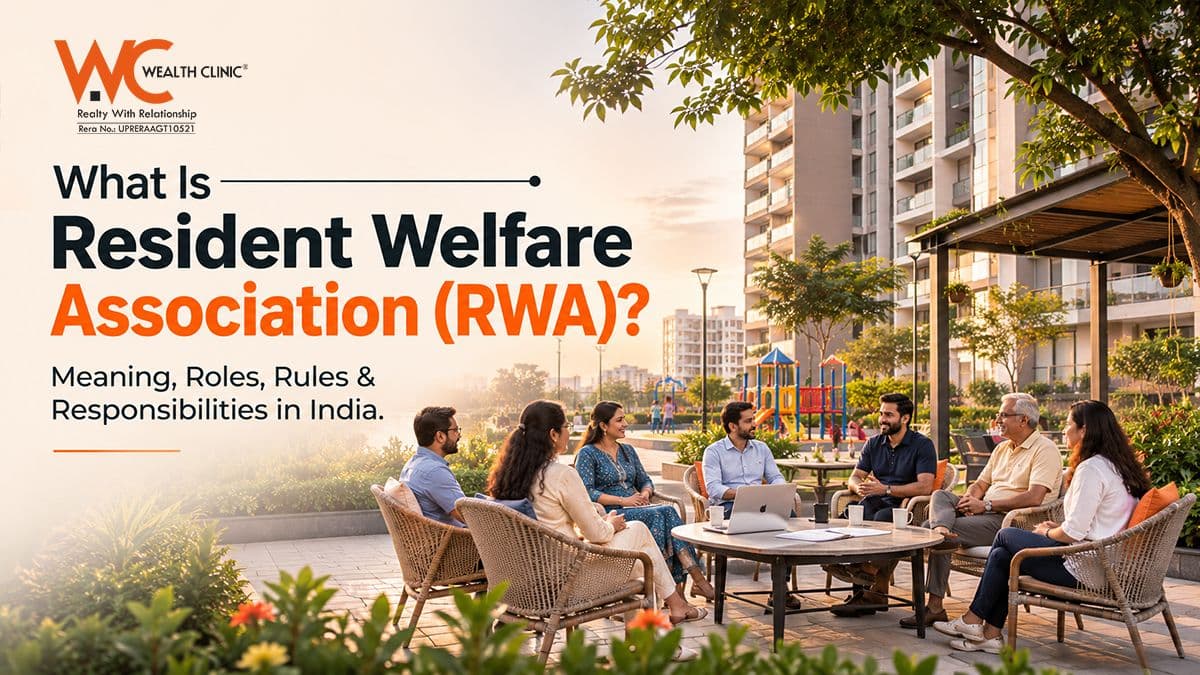
A Resident Welfare Association (RWA) is an organisation formed to manage the common needs and welfare of people living in a residential society, apartment complex, gated community or residential colony. From maintaining common areas and managing security to addressing residents’ complaints and coordinating with local authorities, an RWA plays an important role in the day-to-day functioning of a housing community.
If you are buying a flat or living in a residential society, understanding what an RWA is, what it does, how it is formed and what rights and responsibilities it has can help you make better property decisions.
Explore Wealth Clinic – Your Trusted Real Estate Consultant in India
What Is a Resident Welfare Association?
A Resident Welfare Association, commonly called an RWA, is a resident-led body that represents the collective interests of people living in a residential community.
An RWA may look after facilities such as:
- Security and visitor management
- Cleaning and maintenance of common areas
- Parks and community spaces
- Parking management
- Lifts and other shared facilities
- Water and sanitation-related issues
- Waste management
- Street lighting and other civic concerns
- Community events and welfare activities
- Resident complaints and disputes
The exact powers and responsibilities of an RWA depend on the applicable state law, registration documents, apartment ownership framework and the association's bye-laws. For example, apartment-owner associations can have specific responsibilities regarding common areas and facilities under applicable state legislation.
Explore Wealth Clinic – Your Trusted Real Estate Consultant in India
RWA Full Form
RWA full form is Residents Welfare Association.
It is generally formed to represent residents collectively and help manage common facilities, community services and welfare-related matters in a residential area.
An RWA is different from an individual resident. It represents the collective interests of the community, rather than dealing with every issue separately at an individual level.
Why Is an RWA Important?
Living in a residential society means sharing several facilities and services with other residents. Managing these facilities requires coordination.
For example, residents may need to decide:
- How much maintenance should be collected?
- Who will manage security?
- How should visitor entry be controlled?
- Who will maintain the parks and lifts?
- What are the parking rules?
- How should waste be managed?
- How should common-area repairs be funded?
An RWA provides a structured system for handling these issues.
A well-managed RWA can therefore contribute to better maintenance, improved security, transparent financial management and a better overall living experience.
What Are the Main Responsibilities of an RWA?
The responsibilities of an RWA can vary depending on the society's rules and applicable laws. However, its common responsibilities generally include the following.
1. Maintenance of Common Areas
One of the most visible responsibilities of an RWA is maintaining shared areas of the residential community. This can include:
- Lobbies
- Parks
- Roads within the community
- Staircases
- Lifts
- Clubhouses
- Community halls
- Parking areas
- Street lights
- Other common facilities
Regular maintenance helps keep the society clean, functional and comfortable for residents.
2. Managing Security
Security is another important responsibility. RWAs may coordinate with security agencies and manage systems such as:
- Security guards
- CCTV cameras
- Visitor management
- Entry and exit systems
- Delivery access
- Emergency response procedures
The objective is to make the residential community safer for homeowners, tenants, children and senior citizens.
3. Collecting Maintenance Charges
RWAs may collect maintenance charges from residents according to the applicable rules and bye-laws. These funds can be used for expenses such as:
- Security
- Cleaning
- Electricity for common areas
- Lift maintenance
- Landscaping
- Repairs
- Water-related services
- Other community facilities
The collection and utilisation of these funds should be handled transparently and according to the applicable legal framework and association rules.
4. Managing Society Finances
Financial management is an important part of RWA operations. An RWA may maintain records of:
- Maintenance collections
- Vendor payments
- Repair expenses
- Utility expenses
- Salaries
- Reserve or sinking funds
- Other community-related expenses
Regular financial reporting and appropriate audits can help residents understand how community funds are being used.
5. Resolving Resident Complaints
An RWA can provide residents with a platform to raise common community-related concerns. These may include:
- Parking disputes
- Noise complaints
- Common-area usage
- Maintenance issues
- Security concerns
- Waste disposal
- Society rule violations
The RWA may attempt to resolve such matters through discussions, meetings and the procedures specified in its bye-laws. However, an RWA does not replace courts, government authorities or statutory bodies where a matter requires formal legal action.
6. Managing Parking
Parking can become a major issue in large residential societies.
RWAs may establish parking rules covering:
- Allocation of parking spaces
- Visitor parking
- Two-wheeler parking
- Parking stickers
- Improper parking
- Emergency access
The rules should be consistent with the applicable laws and the society's governing documents.
7. Coordinating With Local Authorities
An RWA can act as a collective representative of residents when communicating with municipal authorities or other government departments.
For example, it may raise concerns regarding:
- Garbage collection
- Roads
- Drainage
- Street lighting
- Water supply
- Public sanitation
- Traffic and civic infrastructure
This makes it easier for residents to raise community-wide issues through a common platform.
Who Manages an RWA?
An RWA is generally managed by an elected governing committee. The exact structure can differ between associations. Common positions include:
How Is an RWA Formed?
The process of forming an RWA can differ depending on the state and type of residential development. Broadly, the process may involve:
- Residents coming together to form an association.
- Defining the objectives and rules of the association.
- Preparing the required constitutional documents.
- Selecting or electing office bearers.
- Registering the association with the appropriate authority, where registration is applicable.
- Operating according to its registered documents and bye-laws.
The Societies Registration Act, 1860 is one legal framework under which associations may be registered, but state-specific laws and apartment ownership legislation can also apply. Therefore, homeowners should check the rules applicable to their particular state and property.
What Are RWA Rules?
RWA rules are guidelines created to maintain discipline and smooth functioning within a residential community.
Depending on the society, these rules may cover:
- Parking
- Visitor entry
- Noise levels
- Use of common facilities
- Waste disposal
- Pet-related matters
- Renovation work
- Moving in and moving out
- Maintenance payments
- Use of community halls
- Security procedures
However, RWA rules cannot simply override applicable laws or the legal rights of property owners. Residents should therefore check the registered bye-laws and relevant state laws when there is a dispute.
RWA Maintenance Charges: What Do They Cover?
RWA maintenance charges are generally collected to operate and maintain shared facilities.
Depending on the community, charges may contribute towards:
- Security services
- Housekeeping
- Landscaping
- Common-area electricity
- Lift maintenance
- Repairs
- Water and sanitation services
- Common facilities
- Administrative expenses
- Other approved community services
The exact amount depends on factors such as the size of the property, facilities available, maintenance requirements and the society's applicable rules.
Before buying a property, buyers should ask for details of the current maintenance charges, pending dues and any upcoming major repair or maintenance expenses.
RWA vs Builder: What Is the Difference?
A builder and an RWA have different roles.
Builder: The builder develops and sells the project and is responsible for construction and other obligations under applicable laws and agreements.
RWA/Association: The association primarily represents residents or apartment owners and manages community-related matters according to applicable laws and governing documents.
In many projects, the transition from developer-led management to resident-led management can be an important stage in the life of a housing society.
RWA vs Society: Are They the Same?
The terms are sometimes used interchangeably, but they can refer to different legal or organisational structures.
An RWA is generally a residents' welfare association, while a housing society or cooperative housing society may be formed and governed under specific state cooperative laws.
Similarly, an apartment owners' association may operate under applicable apartment ownership legislation.
Therefore, buyers should not assume that every residential community has exactly the same legal structure. The project's registration documents and applicable state laws should be checked.
Benefits of Having an Active RWA
A properly functioning RWA can provide several benefits to residents:
- Better management of common facilities
- Faster communication with residents
- Improved security coordination
- Transparent handling of community expenses
- A platform for resolving everyday disputes
- Better coordination with government authorities
- Community development initiatives
- Improved maintenance standards
Good management can also make a residential community more attractive to potential buyers and tenants.
What Should Homebuyers Check About an RWA Before Buying a Flat?
If you are planning to purchase a property in an apartment society, don't only check the flat itself. It is also useful to understand how society is managed.
Before buying, ask about:
1. Monthly maintenance charges- Find out the current maintenance amount and what it includes.
2. Pending maintenance dues- Check whether the property has any outstanding society dues.
3. RWA or association structure- Understand who currently manages the society.
4. Society bye-laws- Review important rules related to parking, renovation, pets, common facilities and other matters.
5. Major upcoming expenses- Ask whether the society is planning major repairs or infrastructure upgrades.
6. Common facilities- Check whether lifts, security systems, parks, clubhouse facilities and other amenities are properly maintained.
7. Dispute history- If possible, understand whether there are major ongoing disputes involving the association, developer or residents.
These checks can help you avoid unexpected expenses and understand the actual living conditions of the community.
Final Thoughts
A Resident Welfare Association is an important part of organised community living in India. Its role goes beyond collecting maintenance charges. From managing common facilities and security to addressing resident concerns and coordinating with civic authorities, an effective RWA can significantly influence the quality of life within a residential society.
For homebuyers, understanding the RWA's rules, maintenance charges, financial management, association structure and pending issues should be part of the property due-diligence process.
The most important point is that RWA powers and responsibilities are not identical across every state or housing project. Always check the applicable state law, registered documents and society bye-laws before making decisions on legal or financial matters.
Frequently Asked Questions

Disclaimer
Wealth Clinic is a real estate consulting and marketing company offering property advisory services to homebuyers and investors. Project details, pricing, layouts, specifications, and availability are provided by respective developers or publicly available sources and may change without notice. Wealth Clinic does not own or develop the listed projects and acts solely as a consulting partner. All bookings and agreements are between the buyer and the respective developer. Buyers are advised to verify project details, RERA registration, pricing, approvals, and legal documents with the developer before making any purchase or investment decision.