What Is an Aerotropolis and Why Is YEIDA Building One?

 Facebook
 LinkedIn
 WhatsApp
 X
The future of a city is often shaped by the infrastructure that connects it to the rest of the world. Roads help cities expand, metro networks improve daily mobility, and airports connect businesses to national and international markets. But what happens when an airport becomes the centre of an entire economic and urban development strategy?
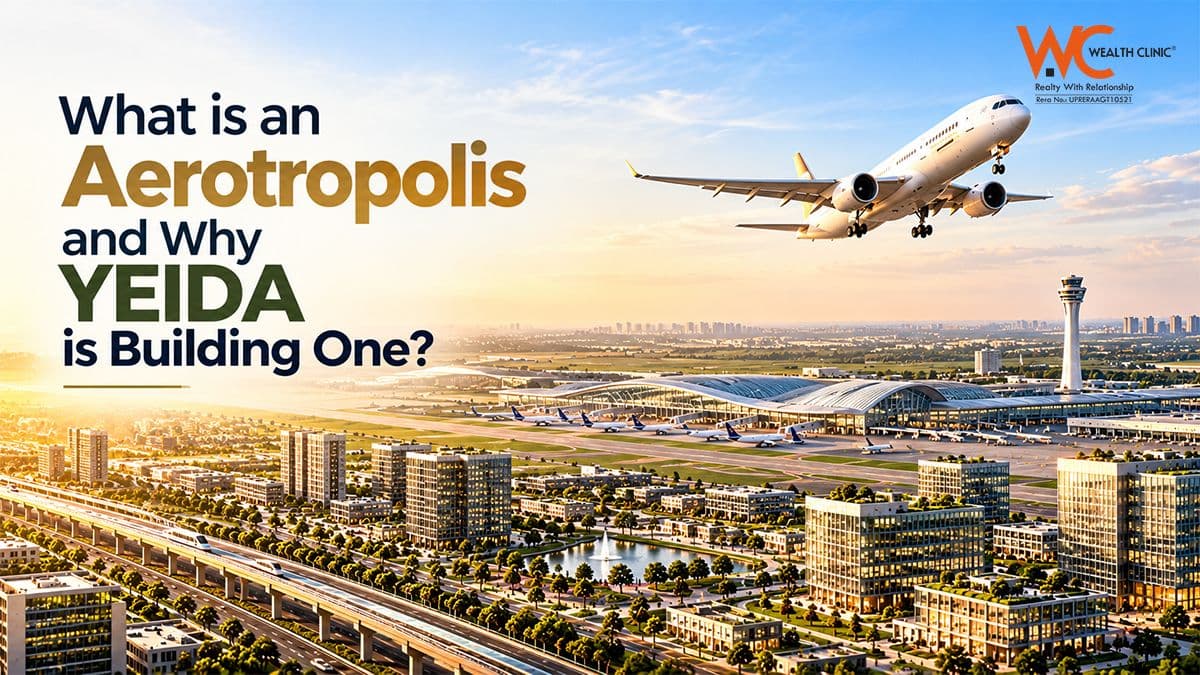
This is the idea behind an aerotropolis, a city or metropolitan region planned around a major airport, with businesses, logistics facilities, commercial districts, hotels and residential communities developing around it.
Along the Yamuna Expressway, this concept is an important part of the long-term development vision of the Yamuna Expressway Industrial Development Authority (YEIDA). The authority's Master Plan 2041 identifies airport-led economic growth as a key opportunity and aims to integrate employment, infrastructure, logistics and urban development around Noida International Airport.
For real estate buyers and investors, understanding the aerotropolis concept helps explain why the Yamuna Expressway region is attracting attention beyond airport construction alone.
Explore Properties in Yamuna Expressway | Book a Free Consultation
What Is an Aerotropolis?
An aerotropolis is an urban and economic region organised around an airport, where transport connectivity, commercial activity and supporting infrastructure are planned to work together.
The concept goes beyond building an airport with a few hotels and offices nearby. A well-planned aerotropolis connects the airport with logistics hubs, industrial zones, business districts, hospitality facilities, residential areas and transport corridors.
The International Civil Aviation Organization (ICAO) describes an aerotropolis as a metropolitan sub-region whose infrastructure, land use and economy are centred on an airport.
In a traditional city, businesses often develop around a central business district. In an aerotropolis, the airport becomes a major economic anchor because it supports the movement of people, goods and time-sensitive services.
How Does an Aerotropolis Work?
An aerotropolis develops through the interaction of several connected sectors:
- Airport and aviation: Passenger services, airlines, aircraft maintenance and other aviation-related operations.
- Logistics and cargo: Warehousing, freight handling, distribution centres and supply-chain services.
- Industrial development: Manufacturing, electronics, technology and other businesses that benefit from transport connectivity.
- Commercial infrastructure: Offices, retail centres, hotels, restaurants and business services.
- Residential development: Housing for employees, professionals, families and supporting service workers.
- Urban infrastructure: Roads, public transport, utilities, healthcare, education and recreational spaces.
These elements are interdependent. An airport can attract businesses, businesses can create employment, and employment can support demand for housing and local services. However, the scale of this effect depends on actual investment, connectivity, job creation and the pace of development.
Why Is YEIDA Planning an Aerotropolis?
YEIDA's long-term planning approach recognises the economic potential of Noida International Airport and the surrounding development corridor. Its Master Plan 2041 aims to create a well-connected, sustainable urban and economic region, with airport-related development forming an important part of the overall vision.
The objective is not simply to develop land around an airport. It is to create an ecosystem in which transport infrastructure, industries, commercial facilities and residential communities can support one another.
1. To Turn Airport Connectivity into Economic Activity
An airport's economic influence can extend well beyond its terminal. Businesses involved in air cargo, international trade, aviation services and time-sensitive manufacturing may value locations that offer efficient access to air transport.
For the Yamuna Expressway region, airport-led development could help attract businesses that depend on fast passenger movement or reliable cargo connections. This may also encourage supporting services such as hotels, offices, food services and business facilities.
However, an airport alone does not guarantee an economic boom. The results depend on airline and cargo activity, business investment, transport links and the ability to attract companies that create sustained employment.
Explore Properties in Yamuna Expressway | Book a Free Consultation
2. To Support Industrial and Logistics Growth
Industrial development is an important part of the wider YEIDA development strategy. The region includes planned industrial areas and projects across sectors such as electronics, manufacturing, food processing, data centres and medical devices.
An aerotropolis can complement these activities by connecting businesses to suppliers, customers and distribution networks. Logistics parks and cargo facilities can also support the movement of goods, particularly for businesses where delivery time and supply-chain efficiency matter.
YEIDA's Master Plan 2041 specifically identifies logistics facilities near the airport as part of its development vision.
The potential benefit is a more connected business ecosystem. Its actual success, however, will depend on how many projects become operational and whether businesses find the region commercially competitive.
3. To Create Employment Beyond Airport Operations
An airport directly supports jobs in aviation, passenger services, security, ground handling, maintenance and cargo operations. An aerotropolis aims to widen that employment base by attracting companies and services around the airport.
Potential employment sectors include manufacturing, warehousing, transport, hospitality, offices, retail and technical services.
As employment grows, workers may need homes, schools, healthcare, shopping facilities and public transport. This creates a possible link between economic development and residential demand.
For property buyers, the important indicator is not simply the number of projects announced. It is whether those projects progress, generate jobs and attract people who need accommodation in accessible locations.
4. To Develop an Integrated Urban Region
YEIDA's Master Plan 2041 also emphasises planned urban development, public transport, affordable housing for industrial workers, green buffers and supporting infrastructure.
These elements matter because an airport-led economic region needs more than industrial land and commercial buildings. It also needs places where people can live, commute, access services and participate in community life.
The planning challenge is to coordinate residential growth with employment centres, road capacity, public transport, water supply, sewage systems, healthcare, education and environmental protection.
If these components develop together, the region may become more practical for residents and businesses. If they develop unevenly, some locations may face long commutes, limited services or slower occupancy.
Noida International Airport: The Centre of YEIDA's Aerotropolis Vision
Noida International Airport is a major infrastructure project influencing the long-term development outlook of the Yamuna Expressway region. Its importance lies not only in passenger travel but also in the potential for cargo, aviation-related businesses, hospitality and supporting commercial activity.
YEIDA's planning framework identifies an airport and aviation hub in the southern part of its Phase-I area, with supporting activities that include logistics, business zones, commercial facilities, hospitality and recreation. The plan describes this as a self-contained development connected to major transport corridors.
The airport's wider economic influence will depend on how these activities are implemented and connected to surrounding development zones.
Why Airport
Linked Development Matters for Real Estate
Real estate demand is often influenced by accessibility and employment. When businesses establish operations in a region, they may need offices, industrial premises, warehouses and accommodation for employees.
An airport-led economic ecosystem could therefore influence several property categories:
- Residential housing for employees and professionals.
- Commercial spaces for businesses and service providers.
- Hotels and serviced accommodation for travellers and business visitors.
- Warehouses and logistics facilities for cargo-related activities.
- Retail and neighbourhood services for a growing population.
These are potential demand channels, not guaranteed outcomes. The effect on any particular property will depend on its exact location, permitted land use, accessibility, price and competition from other developments.
What Does YEIDA's Aerotropolis Mean for Yamuna Expressway Real Estate?
For property buyers, the aerotropolis concept offers a useful way to understand the broader development story. Instead of evaluating the Yamuna Expressway only as a road corridor or a location near an airport, buyers can assess how different economic activities may influence future demand.
Residential Property: Look for Real Housing Demand
Residential demand may grow where employment centres, transport connections and everyday services become accessible. Buyers should evaluate whether a location is suitable for actual occupation, rather than relying only on projected future development.
Important considerations include road access, nearby social infrastructure, commuting options, construction quality and the availability of essential services.
Commercial Property: Assess Business Activity
Retail and office spaces may benefit when businesses, residents and visitors create regular demand. But commercial property can carry vacancy risk, maintenance costs and longer leasing periods.
Before investing, buyers should assess competing supply, realistic rents, occupancy assumptions and the property's practical accessibility. A location near an airport does not automatically guarantee tenants.
Industrial and Logistics Property: Verify the Permitted Use
Industrial and logistics properties require additional due diligence. Buyers should confirm the exact land-use category, applicable authority approvals, access for commercial vehicles, utilities and any environmental or operational requirements.
Land marketed as being near an industrial or airport development zone should not be assumed to be approved for every type of construction or business.
Aerotropolis vs Traditional City: What Is the Difference?
An aerotropolis is not separate from a city in the conventional sense. It is a development model that gives the airport a central role in organising economic activity and infrastructure.
What Should Property Buyers Check Before Investing in the YEIDA Region?
The aerotropolis vision may strengthen interest in the Yamuna Expressway region, but buyers should still evaluate individual properties carefully.
Before making a purchase, check the following:
- Land use: Confirm whether the property is approved for residential, commercial, industrial or another specified use.
- Ownership and title: Review ownership records, title documents and any applicable encumbrances.
- Project approvals: Verify the relevant authority approvals and sanctioned plans.
- RERA registration: Check registration where applicable and review the project's declared details.
- Connectivity: Assess existing road access and the actual status of proposed transport infrastructure.
- Development timelines: Distinguish between operational facilities, projects under construction and proposals.
- Total cost: Include taxes, registration, maintenance, financing and other applicable expenses.
- Exit and rental prospects: Consider likely end-user demand, competing supply, vacancy risk and resale liquidity.
Most importantly, do not assume that every property within the broader airport region will benefit equally. The value of a specific asset depends on its legal status, location, pricing, infrastructure and real market demand.
What Are the Challenges in Building an Aerotropolis?
Developing an aerotropolis is a long-term planning exercise, and several challenges can affect its progress.
Infrastructure coordination: Roads, public transport, utilities and civic services need to keep pace with industrial and residential growth.
Employment creation: Businesses must establish real operations and generate sustained jobs for wider economic benefits to materialise.
Environmental management: Urban expansion needs to account for water resources, green spaces, pollution, airport noise and ecologically sensitive areas.
Affordable housing: Workers and service providers need housing that is accessible to employment centres and affordable relative to their incomes.
Phased development: Different sectors may develop at different speeds. Some locations may attract businesses and residents earlier than others.
These factors explain why the aerotropolis vision should be viewed as a long-term development framework rather than a promise of immediate growth across every part of the region.
Conclusion: YEIDA's Aerotropolis Is About More Than an Airport
An aerotropolis is an airport-centred economic region in which transport infrastructure, businesses, logistics, commercial facilities and residential development are planned to support one another.
YEIDA's Master Plan 2041 reflects this broader approach by identifying airport-led development, logistics, industrial growth, residential planning and supporting urban infrastructure as important elements of the region's future.
For the Yamuna Expressway region, the long-term opportunity will depend on whether the airport attracts sustained business activity, whether industrial projects create employment and whether supporting infrastructure makes nearby areas practical places to live and work.
For real estate buyers, the right approach is to understand the plan, verify the current status of individual developments and assess each property on its own merits. The aerotropolis concept can help explain where demand might emerge, but legal due diligence, realistic pricing and actual market fundamentals should guide the final decision.
Frequently Asked Questions

Disclaimer
Wealth Clinic is a real estate consulting and marketing company offering property advisory services to homebuyers and investors. Project details, pricing, layouts, specifications, and availability are provided by respective developers or publicly available sources and may change without notice. Wealth Clinic does not own or develop the listed projects and acts solely as a consulting partner. All bookings and agreements are between the buyer and the respective developer. Buyers are advised to verify project details, RERA registration, pricing, approvals, and legal documents with the developer before making any purchase or investment decision.