 Facebook
 LinkedIn
 WhatsApp
 X
X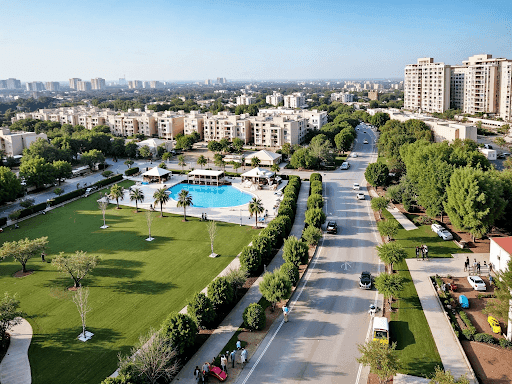
With urbanization happening at a very high rate these days, cities worldwide are learning to focus more on sustainability with respect to economic growth, environmental conservation, and improved quality of life. Greater Noida, a developing city in India, has a vital role in the Global Sustainable Cities 2025 initiative, tying its growth strategies with the UN sustainability goals for a greener and more efficient urban environment.
Commitment to Sustainability
Greater Noida, a city with a futuristic outlook on urban planning and infrastructure development, is moving towards implementable policies and programs under the Sustainable Cities 2025 agenda as an example for all emerging urban centers.
This city is prioritizing green buildings, alternative modes of transport, waste management as well as the incorporation of renewable energy.
Smart Infrastructure and Green Buildings
Infrastructure is one of the key motors of the sustainability drive in Greater Noida, as the majority of the green-certified buildings in the city are energy-efficient constructions. These buildings even have elements such as rainwater harvesting systems and green materials aimed at minimizing carbon footprints.
The Greater Noida Industrial Development Authority (GNIDA) had arranged for an online e-auction, promising institutional plot schemes. This initiative offers opportunities to nursing homes, schools, training centers, and hospitals to grab prime land in Greater Noida. This scheme revolves around sustainable development, thus transforming Greater Noida into a healthcare and educational hub. Selected by the UN for the Global Sustainable Cities 2025 Initiative, Greater Noida stands out amidst the crowd!
Sustainable Transportation
In addition, Greater Noida has substantially increased its metro connectivity to be able to provide affordable and efficient public transit. This is expected to reduce reliance on private vehicles and thus carbon emissions. For instance, construction of the Aqua Line metro is on to connect Noida and Greater Noida.
The city also offers excellent cycling tracks and paths for skywalkers and non-motorized transport. It focuses on electric transport and has introduced electric buses and charging stations to further deliver the Sustainable Cities 2025 vision with less pollution and less use of fossil fuels.
Waste Management and Renewable Energy Initiatives
Greater Noida has been doing well in implementing waste management processes. The city has been introducing waste segregation programs, starting composting, creating recycling centers, and promising to have a new waste-to-energy plant, all aimed at minimizing landfill waste based on the concepts of a circular economy.
In energy, it is further developing solar energy by imposing a cost incentive for the installation of solar panels in residential as well as commercial premises by smart grid technology, bringing the city towards fulfilling UN sustainability goals.
Conclusion
Greater Noida is evolving as a nexus of sustainable urban development that will catalyze innovative interventions with the Global Sustainable Cities 2025 framework. It is galloping towards greater sustainability, with green infrastructure, efficient transportation, waste management, and renewable energy, thereby establishing a classical precedent for other cities worldwide to achieve rapid growth with environmental responsibility.
Frequently Asked Questions

Disclaimer
Wealth Clinic is a real estate consulting and marketing company offering property advisory services to homebuyers and investors. Project details, pricing, layouts, specifications, and availability are provided by respective developers or publicly available sources and may change without notice. Wealth Clinic does not own or develop the listed projects and acts solely as a consulting partner. All bookings and agreements are between the buyer and the respective developer. Buyers are advised to verify project details, RERA registration, pricing, approvals, and legal documents with the developer before making any purchase or investment decision.